-
Xuntong specializes in testing services for electrical accessories, consumer electronics, lighting, wireless, toys and other products.




RoHS testing
RoHS is a mandatory standard formulated by EU legislation. Its full name is the Directive on Restricting the Use of Certain Hazardous Ingredients in Electrical and Electronic Equipment. This standard was officially implemented on July 1, 2006. It is mainly used to standardize the material and process standards of electronic and electrical products to make it more conducive to human health and environmental protection. The purpose of this standard is to eliminate lead, mercury, cadmium, hexavalent chromium, polybrominated biphenyls and polybrominated diphenyl ethers in electronic and electrical products, and add 4 o-benzene items, for a total of 10 substances.
standards and regulatory requirements
EU Regulation/Directive: 2011/65/EU
2011/65/EU Hazardous Substances and Limit Requirements: The maximum allowable concentration of hazardous substances in homogeneous materials is:
Maximum allowable concentration of restricted substances lead 0.1% mercury 0.1% cadmium 0.01% hexavalent chromium 0.1% polybrominated biphenyl 0.1% polybrominated diphenyl ether 0.1% bis (2-ethylhexyl) phthalate 0,1% methylphenyl butyl phthalate 0.1% dibutyl phthalate 0.1% diisobutyl phthalate 0.1% standard and regulatory requirements
RoHS2.0
RoHS 2.0 (2011/65/EU) came into effect on July 21, 2011 and was officially implemented on January 3, 2013 (2002/95/EC repealed on the same day). RoHS 2.0 expands the product scope to eleven categories based on the original RoHS Directive, requiring all member states to ensure that EEE, including its repair parts or reuse or cables or components that upgrade its functions/capacity, comply with the requirements of the new Directive. RoHS 2.0 provides a clear definition of homogeneous materials and stipulates the respective responsibilities and obligations of manufacturers, authorized representatives, importers, sellers, etc.; manufacturers must draft necessary technical documents during the production process and implement internal production control procedures in accordance with Model A specified in Appendix II of Decision 768/2008/EC. At the same time, they must provide a declaration of compliance. The CE mark can be affixed to the final product only after the product is qualified.

At the same time, manufacturers are required to keep relevant technical documents and declare compliance for 10 years after the product is put on the market. The directive involves 41 exemption items and will be updated continuously.
China RoHS
Measures for the Control and Management of Pollution of Electronic Information Products (Implementation Date: March 1, 2007)
The “Administrative Measures for the Control of Pollution in Electronic Information Products”(hereinafter referred to as the Administrative Measures) jointly issued by seven ministries and commissions of the country stipulates that electronic information products should comply with the national standards for the control of toxic and harmful substances or elements in electronic information products during the design, production and sales process. or industry standards. Enterprises must mark the names and contents of toxic and harmful substances or elements, and mark the environmentally friendly use period of electronic information products. The management measures adopt a “two-step” approach. The first step is to require electronic information products entering the market to disclose relevant environmental protection information in the form of self-declaration from the effective date of the management measures.
Standards implemented in conjunction with the management measures include: SJ/T11363-2006 “Limit Requirements for Toxic and Hazardous Substances in Electronic Information Products”(replaced by GB/T26572-2011), SJ/T11364-2006 “Identification Requirements for Pollution Control of Electronic Information Products” and SJ/T11365-2006 “Detection Methods of Toxic and Hazardous Substances in Electronic Information Products”(replaced by GB/T26125-2011/IEC62321:2008). SJ/T11363-2006 stipulates that the content of lead (Pb), mercury (Hg), hexavalent chromium (Cr (VI)), polybrominated biphenyls (PBBs) and polybrominated diphenyl ethers (PBDEs) in each testing unit shall not exceed 1000ppm respectively, and the content of cadmium (Cd) shall not exceed 100ppm; According to SJ/T11364-2006, if a toxic and harmful substance or element is not contained in the homogeneous material of electronic information products, or the content is below the limit requirements specified in SJ/T11363-2006, the corresponding content of the toxic and harmful substance or element is marked as “○”; If a toxic and harmful substance or element is contained in the component, that is, the content exceeds the limit requirements specified in the SJ/T11363-2006 standard, the corresponding content of the toxic and harmful substance or element is marked as “×”, as shown in the following table.
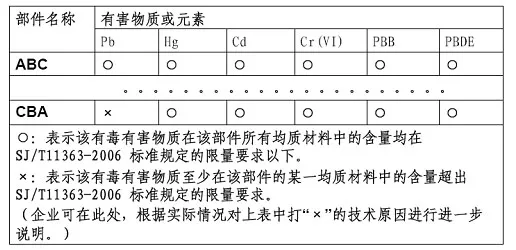

If the product does not contain toxic and harmful substances or elements, that is, it is all marked as “○”, then mark it in green as shown on the left figure below; otherwise, mark it in the right figure below, and provide the names and content of the toxic and harmful substances contained in the product manual.
The second step is to implement strict supervision on products that enter the “Key Management Catalog for Pollution Control of Electronic Information Products”. They need to replace toxic and harmful substances or meet limit requirements, and then pass compulsory certification (3C certification) before they can enter the market.
REACH
overview
REACH Regulation refers to EU Regulation No. 1907/2006 on the registration, evaluation, authorization and restriction of chemicals, namely Registration,Evaluation, Authorization and Restriction of Chemical. REACH regulation is a mandatory regulation in the European Union that provides early warning management of all chemicals entering its market. It has built a vast chemicals management system that requires producers, importers and downstream users of chemicals to be responsible for the safety of the chemicals used in their products to protect human health and environmental safety. The European Chemicals Agency (ECHA) has the overall responsibility for implementing the REACH regulation.
standards and regulatory requirements EU REACH is the abbreviation of the EU Regulation on the Registration, Evaluation, Authorization and Restriction of Chemicals and was fully implemented on June 1, 2007. REACH replaces 40 existing regulations in the EU and becomes a unified set of regulations for the registration, evaluation, licensing and restriction of chemicals. Registration companies submit a note file, detailing the various attributes of the chemicals contained in the product, including use, safety control, risk responsibility, classification and labeling, etc. Evaluation The European Chemicals Agency (ECHA) conducts an evaluation based on the registration file to achieve post-market supervision of the regulations. Authorization Some highly hazardous substances will be included in the authorization list. These substances need to be submitted before use and can be used after authorization
Restriction has incorporated more than 40 existing chemical decrees into the management system, with more than 1000 restricted substances
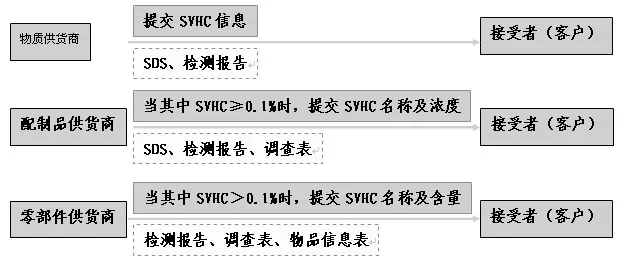
The REACH regulation divides substances into three categories: substances themselves, substances in mixtures, and substances in articles. The REACH regulation has a complete registration and evaluation system, involving more than 30,000 chemical substances, covering almost all products exported to the EU (except food, drugs and pesticides). In response to the SVHC requirements of REACH, all links in the supply chain must bear corresponding obligations:
Substance supplier submits SVHC information———————-recipient (customer)
SDS, test report
When SVHC is greater than or equal to 0.1%, the preparation supplier shall submit the name and concentration of SVHC——– recipient (customer)
SDS, test report, questionnaire
When the part supplier contains SVHC 0.1%, submit the SVHC name and content———-recipient (customer)
Test report, questionnaire, article information form
End products-directly sold to Europe
SVHC name——————-EU consumers
When SVHC is 0.1%
Name and content of SVHC—————–Notification to ECHA
When the SVHC content rate of a single product is 0.1% and all products contain 1T/year
EU importers-indirect sales to Europe
SVHC name——————-EU consumers
When SVHC is 0.1%
Name and content of SVHC—————–Notification to ECHA
When the SVHC content rate of a single product is 0.1% and all products contain 1T/year
Relevant requirements for exporting terminal products to EU countries:
So far, substances of Very High Concern (SVHC) have been listed as candidate substances for SVHC.
China
The “Environmental Management Measures for New Chemical Substances” were promulgated by the Ministry of Environmental Protection of China and will come into effect on October 15, 2010.
Producers or importers of new chemical substances must declare before production or import and obtain a new chemical substance environmental management registration certificate (hereinafter referred to as the “registration certificate”). The production, import, processing and use of new chemical substances without a registration certificate are prohibited. New chemical substances that have not obtained a registration certificate or have not been filed and declared shall not be used for scientific research.
New chemical substances are required to complete declaration and registration before being imported or produced, including scientific research filing declarations, simplified declarations and routine declarations; the application materials may include new test items and chemical safety reports.
According to the identification and classification standards for hazardous characteristics of chemicals, new chemical substances are divided into general new chemical substances and dangerous new chemical substances. Among the new hazardous chemical substances, chemical substances with persistent, bioaccumulative, ecological environment and human health hazards are listed as key environmental management hazardous new chemical substances.
Japan
“Law on Review and Manufacturing Restrictions on Chemical Substances”(referred to as the “Chemical Review Law”).
Introduction to Regulations
Japan’s Chemical Review Law is under the responsibility of the Ministry of Economy, Trade and Industry (METI), the Ministry of Health, Labor and Welfare (MHLW), and the Ministry of the Environment (MOE) and was officially promulgated in 1973.
In 2009, a revised version of Japan’s Chemical Review Law was officially issued to help Japan achieve the 2020 United Nations SAICM goal of sound management of chemicals. Through cross-departmental cooperation among the three provinces, the Chemical Review Law aims to prevent environmental pollution caused by chemicals from causing possible harm to human health, requiring that priority should be given to evaluating the specific hazards of the new chemical before manufacturing or importing chemicals for industrial use. The changes in the revised version of the Japan Chemical Review Law are mainly reflected in the transformation of CSCL into risk-based chemical management regulations, the introduction of a comprehensive management system covering existing chemical substances, and the introduction of requirements, evaluation and management for the reasonable supervision of chemical substances in the supply chain. Rationalization of the framework and requirements for notification of chemical information to relevant departments
CPSIA
1. overview
The U.S. Consumer Product Safety Improvement Act of 2008 officially became law in August 2008 (Public Law Number: 110-314). The law is said to be a 1972 Consumer Product Safety Commission The most stringent consumer protection law since the establishment of (CPSC), in addition to imposing stricter lead limits on children’s products, also imposes permanent restrictions on three harmful phthalates (di-2-ethylhexyl phthalate DEHP, dibutyl phthalate DBP, butylbenzyl phthalate BBP) in toys and child care products, and restricts three other phthalates.(Diisonononyl phthalate DINP, diisodecyl phthalate DIDP, dioctyl phthalate DNOP) Implement the transitional period order. In addition, the regulation also increases the Consumer Product Safety Commission’s budget and expands its enforcement powers, including protecting whistleblowers and requiring certain children’s products to undergo third-party testing before being sold.
2. Limitations on lead content of non-surface coating materials for children’s products:
Limit the lead content of children’s product components. This requirement will be implemented in stages, with the ultimate goal of reducing the limit for total lead content in any accessible part of the product to no more than 0.01%(100ppm) by weight. The regulation also requires the Consumer Product Safety Commission to regularly evaluate this requirement and make necessary modifications (lower limits).
1. Lead content limit (total lead content as a proportion of weight):
*0.06%(600ppm), implemented 180 days after the regulation came into effect (February 10, 2009);
*0.03%(300ppm), implemented 1 year after the regulation came into effect (August 14, 2009);
*0.01%(100ppm), implemented 3 years after the regulation came into effect (August 14, 2011);
2. Exposure to hazardous substances:
* The above limits do not apply to parts of children’s products that are not accessible to children during reasonably foreseeable use or abuse;
* Within one year after the regulation takes effect (before August 14, 2009), the Consumer Product Safety Commission should publish rules to provide guidance on which product components may be considered inaccessible;
:: Paint, coating or plating cannot be considered a barrier that prevents children from reaching the underlying lead;
* The Consumer Product Safety Commission should study to determine whether electronic equipment and batteries need to fully meet limit requirements.
Restrictions on lead paint are stricter:
The limit for lead content in lead-containing paints (16CFR1303.1) was reduced from 0.06% to 0.009%, and the regulation came into effect one year after it came into effect (August 14, 2009).
Product safety certification:
1. General Certificate of Conformity
Starting 90 days after the regulation took effect (November 12, 2008), U.S. importers and U.S. manufacturers of controlled products are required to provide certificates proving that their products comply with the requirements of applicable standards and regulations. Regulated products include all products controlled under the Consumer Product Safety Act and all other similar guidelines, bans, standards or regulations implemented by the Consumer Product Safety Commission.
PAHs
1. Overview
Polycyclic Aromatic Hydrocarbons (PAHs) are a class of organic compounds with two or more benzene rings. Polycyclic aromatic hydrocarbons are hydrocarbons with more than two benzene rings in their molecules, including more than 150 compounds such as naphthalene, anthracene, phenanthrene, and pyrene.
2. Standards and regulatory requirements
So far, what countries and regions have determined through written laws or decrees are:
EU: REACH Annex 17;
Germany: GS certification
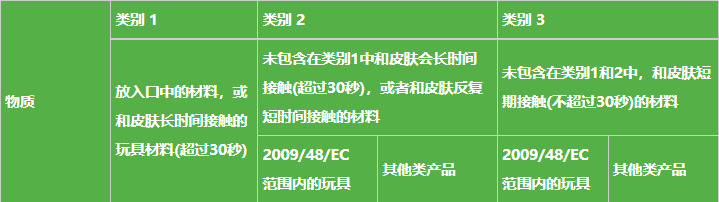
Article 50 of Annex 17 of the REACH Regulation involves eight PAHs: benzo (a) pyrene (BaP), benzo (b) pyrene (BeP), benzoanthracene (BaA), chrysalis (CHR), benzo (b) fluoranthene (BbFA), benzo (j) fluoranthene (BjFA), benzo (k) fluoranthene (BkFA), and dibenzoanthracene (DBAhA). It stipulates that the total mass fraction of eight PAHs in tire extender oil is ≤0.001%, of which the mass fraction of BaP is ≤0.0001%.
|
In the GS certification, the ZEK01.4-08 standard is used to detect the 18 PAHs involved. The substances involved are as follows: On August 4, 2014, the German Technical Equipment and Consumer Goods Commission (ATAV) announced new control requirements for polycyclic aromatic hydrocarbons (PAH) for products requiring GS certification, which will take effect on July 1, 2015. Table 1: Restrictions on PAH in the new standard (unit: mg/kg) Benzo (a) pyrene 0.2 0.2 0.5 0.5 1 Benzo (e) pyrene 0.2 0.2 0.5 0.5 1 Benzo (a) anthracene 0.2 0.2 0.5 0.5 1 Benzo (b) fluoranthene 0.2 0.2 0.5 0.5 1 Benzo (j) fluoranthene 0.2 |
|||||
<0.2 0.5 0.5 1 Benzo (k) fluoranthene 0.2 0.2 0.5 0.5 1 Qu 0.2 0.2 0.5 0.5 1 Dibenzo (a,h) anthracene 0.2 0.2 0.5 0.5 1 Benzo (g,h,i) perylene 0.2 0.2 0.5 0.5 1 Indenazole (1,2,3-cd) pyrene 0.2 0.2 0.5 0.5 1 Acenaphthene, fluorephenanthrene, pyrene, anthracene and fluoranthene 1 Total 5 Total 10 Total 20 Total 50 Total naphthalene 1 2 1018 PAH Total 1 5 10 20 50
Proposition 65
overview
California’s Proposition 65, the Drinking Water Safety and Toxic Substances Enforcement Act of 1986, was promulgated in November 1986. Its purpose is to protect California residents and the state’s drinking water sources so that the water sources do not contain substances known to cause cancer, Birth defects or other reproductive and development hazards, and truthfully notify residents when such substances appear in products. California’s 65 Controlled Substances List was issued by OEHHA and updated quarterly. It was first published in 1987. Products sold in California must comply with California Act 65.
The list is updated at least annually;
Currently, more than 960 chemical substances have entered the substance list.
Which consumer products have been subject to litigation?
The emerging litigation against manufacturers and retailers involves a wide range of consumer goods areas, including:
·Earphones·Cameras·Audio·Toys·Ceramic tableware·Crystal products·Correction fluid·Outdoor decorative glass products·Textiles·Jewelry·Lead fishing gear·Nail polish·Dental fillers· PVC computer peripherals· PVC electrical tape· PVC optical fiber cable· PVC lunch box·Paint
limit standard
California 65 regulates and evaluates whether specific products contain toxic substances based on court cases involving similar products. It is not recommended to test the more than 960 chemicals on the list one by one for a product, because it is almost impossible for a product to contain all the chemicals on the list. The types of chemical substances and limit requirements controlled by specific products need to be based on the latest judgments in similar product cases. For example, if a company loses a lawsuit for containing lead in a certain component of a product, and the court will impose a limit, then this limit will be used as the limit for lead content in components of this type of product in the future.
For different products and different materials, the chemical substances controlled are different, and the limit requirements are also different. California’s Proposition 65 requires some cases as follows. Material limit requirements for products covered by the project 1 Toys and child care products Lead paint and coating materials ≤90 ppm PVC materials, baby bibs ≤200ppm Other materials ≤600ppm o-phenylDEHP, DBP, BBP, DIDP and DnHP are less than 0.1% respectively 2 Children’s jewelry Cadmium ≤300ppm3 Fashion accessories (clothing such as gloves and hats, bag ornaments and zippers, belts, makeup bags, luggage bags and ID bags, covers for magazines or address books, covers for mobile electronic devices, glasses boxes, footwear, handbags, wallet, coin wallets, jewelry, key chain chains,)
Lead paints and coating materials ≤90ppm Leather ≤300 ppm PVC materials ≤200ppm Other materials ≤300ppm o-benzene DEHP, DBP and BBP are less than 0.1% respectively 4 headphone cord o-benzene BBP, DBP, DEHP,DIDP,DINP,DNHP are less than 0.01% respectively
Phthalates
overview
Phthalates, also known as phthalates, abbreviated as PAE, are the general term for esters formed by phthalic acid. Phthalates are a class of chemicals that can soften them. As plasticizers, they are widely used in toys, food packaging, vinyl floors, wallpaper, cleaners, nail polish, sprays, shampoos and body washes. Hundreds of products. Studies have shown that phthalates can interfere with endocrine, reducing the number of sperm in men, low exercise ability, abnormal shape, and in serious cases, causing death syndrome and testicular cancer, and are the “chief culprit” of male reproductive problems.
standards and regulatory requirements
On December 14, 2005, the European Parliament and Council promulgated the Phthalates Directive (2005/84/EC), which was later replaced by 552/2009/EC, and is currently Annex 17 to the REACH Regulation. The Directive requires that the content of DEHP, DBP and BBP in plastic materials in children’s toys and child care products is less than 1000ppm; the content of DINP, DIDP and DNOP in plastic materials that children can import is less than 1000ppm. All of the above products shall not be placed on the market if they fail to meet the limit requirements.
Following 2005/84/EC, various countries have enacted laws and regulations to control related phthalates in toys. In 2007, the State of California promulgated AB1108 to control ortho-benzene-6P in toys. No one is allowed to produce or sell the following products: children’s toys or child care products with DEHP,DBP, and BBP concentrations exceeding 0.1%; any children’s toys or child care products containing DINP,DIDP, and DNOP concentrations exceeding 0.1%, and suitable for children under 3 years old that can be put into the mouth. In 2008, the United States regulated ortho-benzene-6P in toys under the Consumer Product Safety Improvement Act CPSIA, which stipulates that within 180 days after the Act came into effect (February 10, 2009), it will be deemed illegal to provide the following products: any children’s toy or child care product containing DEHP,DBP,BBP concentrations exceeding 0.1%; any children’s toy or child care product containing DINP,DIDP,DNOP concentrations exceeding 0.1%.
In China, GB24613 -2009 “Limits of Hazardous Substances in Toy Coatings” requires that the total concentration of phthalates DEHP, DBP and BBP in toy coatings be less than 0.1%; the total concentration of DINP,DIDP, and DNOP shall not exceed 0.1%. Japan, Canada and other countries have also formulated control requirements for phthalates in toys. REACH Annex17 ((EC) No 552/2009) DEHP, DBP, BBP; DINP, DIDP, DNOP (toys, children’s products) CPSIA (HR 4040)DEHP, DBP, BBP; DINP, DIDP, DNOP (children’s toys, child care products) California AB 1108DEHP, DBP, DINP, DIDP, DNOP (t children’s toys, child care products)Proposition 65DEHP, DBP, BBP, DIDP, DNHP,DINP
Denmark DEHP, DBP, BBP, DIBP (accessible indoor products) SVHCDEHP, DBP, BBP, DIHP, DHNUP, DMEP, DIPP; n-pentyl isoamyl phthalate; branched and straight diamyl 1,2-benzenedicarboxylate
 WeChat

 Submission Successful
 WeChat Official Account