-
Xuntong specializes in testing services for electrical accessories, consumer electronics, lighting, wireless, toys and other products.



 Service Hotline 18617145297
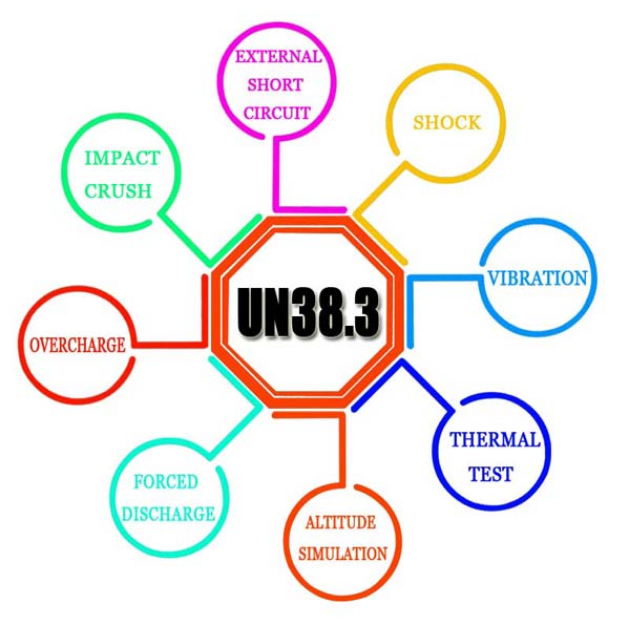
What are the test projects for UN38.3 and why are these tests performed
There are a total of 8 different test projects. Let’s learn about these projects one by one.
T.1 High-altitude simulation test
Common sense tells us that the higher the altitude, the lower the air pressure. As the plane took off from the ground to a cruising altitude of 30000 feet, the air pressure inside the aircraft slowly decreased as the altitude increased. When the plane landed, the air pressure in the cabin gradually increased as the altitude decreased.
Although the aircraft pressurizes and decompresses the cabin during ascent and descent, there will always be an unavoidable pressure difference. If a cargo plane carries lithium batteries/cells, or products with lithium batteries, how can we determine in advance whether the batteries inside the aircraft can withstand pressure changes?
As a result, a test chamber that simulates this high-altitude and low-pressure environment was born. Its principle is very simple: in a sealed test chamber, manually create a specified low-pressure environment, and then put the lithium battery or battery cell in the test chamber. After a specified period of time, the battery or battery cell is taken out to evaluate whether it meets the standard.
T.2 High and low temperature cycle test
At the same time, world temperatures vary greatly between different countries and regions. If the battery is transported from low latitudes to high latitudes, the battery will experience a temperature difference from high to low. Conversely, if transported from high latitudes to low latitudes, the battery will experience a temperature difference from low temperature to high temperature.
Not only that, if transported by cargo aircraft, the temperature during high-altitude flight is lower than that on the ground, and the temperature during landing is also higher than that at high-altitude. If transported by sea, containers filled with lithium batteries/batteries are piled on the deck and will experience huge temperature differences between day and night while sailing on the water.
In short, batteries transported over long distances must withstand extreme temperature changes.
The purpose of thermal testing is to utilize rapid and extreme temperature changes to evaluate the seal integrity and internal electrical connections of lithium batteries and batteries.
T3 vibration test
This test simulates vibration during transportation. Not only batteries, vibration is inevitable for the transportation of any cargo, because the displacement of any object represents the occurrence of motion and is accompanied by vibration.
During loading, unloading, loading, transportation and unloading, vibration is inevitable.
Taking air transportation as an example, in addition to turbulence in the air, the cargo hold vibrates continuously at a fixed frequency, even though the aircraft is usually cruising. This kind of vibration may not be felt by human perception, so it is directly ignored for common goods, but for dangerous and sensitive goods such as batteries, considerable attention must be paid to prevent fire.
We need to simulate this similar environment in advance to see if the battery can maintain stable physical and chemical properties under such vibration conditions without other abnormalities.
T.4 Impact test
When we usually travel on passenger planes, the flight often suddenly experiences ups and downs, side to side, and body vibration. This phenomenon is caused by atmospheric turbulence.
The reason for the plane’s turbulence is the turbulence in the atmosphere, which varies in size, direction and speed.
When the aircraft enters a turbulent vortex of similar size to the aircraft’s body, all parts of the aircraft are affected by airflow in different directions and speeds, and the original balance of aerodynamic force and torque is destroyed, resulting in irregular motion. As the aircraft moves from one vortex to another, it vibrates. When the natural vibration period of the aircraft is the same as the pulse period of turbulence, turbulence becomes very intense.
Once we understand the reasons behind this phenomenon, you must understand the need for impact testing batteries that will be transported by air.
Think about it, if batteries that cannot withstand these shocks collide in the cabin due to bumps at an altitude of 10,000 meters and cause a fire, it would be very terrible and catastrophic.
T.5 External short circuit test
This test simulates an external short circuit. Short circuits in batteries are common faults of batteries, including external short circuits and internal short circuits.
External short circuits generally refer to short circuits caused by direct contact between positive and negative electrodes. Whether it is transported by sea, air or truck, external short circuits can occur in the event of abnormal packaging, unexpected changes in the external environment, or improper human handling.
When the battery is short-circuited, the battery will continue to emit heat, and the temperature is very high enough to melt ordinary metals. If there is no timely heat dissipation, it will burn out the battery and cause fire or even explosion, which will become a serious threat to property and life safety.
We do this external short test to find out if the battery is under control once an external short occurs.
T.6 Impact test
Impact test tests simulate mechanical damage caused by impact or crush that can cause internal short circuits. Internal short circuit means that when the battery is punctured by a sharp object or is hit or squeezed, a short circuit occurs in the area of the battery affected by an external object.
The main purpose of this test is to test the internal stability and safety of the battery to prevent the battery from disintegrating or catching fire due to external uncontrollable factors (such as impact, dumping, collapse, etc.) during shipping, truck or air transportation.
These tests only apply to lithium batteries with a diameter of less than 18 mm.
T.7 Overcharge Test
This test evaluates the performance of a rechargeable battery or a single rechargeable battery to withstand overcharge conditions.
Charge the battery with charging current and charging voltage that exceed the values specified by the battery manufacturer to see whether the sample can meet the requirements of not being disassembled and not catching fire.
T.8 Forced discharge test
This test evaluates the ability of a primary or rechargeable battery to withstand forced discharge conditions. Each battery is connected in series with a 12V DC power supply with an initial current equal to the maximum discharge current specified by the manufacturer.
 WeChat


 Submission Successful
 WeChat Official Account