-
Xuntong specializes in testing services for electrical accessories, consumer electronics, lighting, wireless, toys and other products.



 Service Hotline 18617145297
IP grade enclosure
When product engineers want to have a “waterproof” enclosure, they often don’t know what type of IP rating to look for. Much like watches or other sensitive information, there are big differences between waterproof, water-resistant, and other descriptive rather than specific tags. To help, multiple rating systems and several testing bodies have been developed to verify results. Among them, the two most famous are NEMA and IP. This article will only cover IP systems.
What is IP level?
IP rating (Intrusion Protection Level) is a level used to classify the different levels of sealing effect provided by electrical enclosures against foreign objects such as objects, water, and dirt.
IP Level Table
For enclosures, typical waterproof IP ratings are IP67, IP66 and IP65 enclosures. The following table details what these ratings mean and how they are measured.
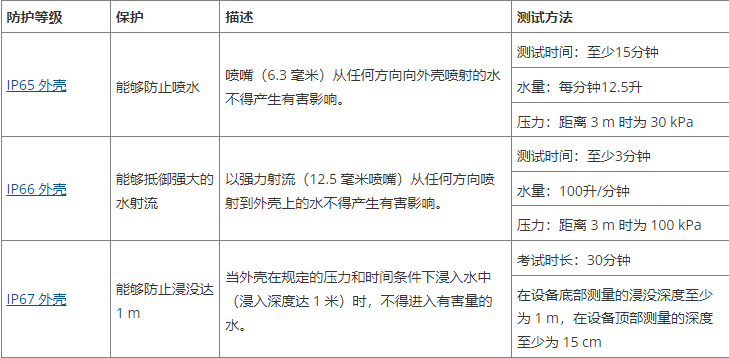
The IP rating or entry protection is developed by the IEC (International Electrotechnical Commission) and is most widely used in Europe and Asia, with some advocates in North America. Because these are international standards, testing is usually certified by TUV rather than UL, although both provide rigorous testing. One aspect to note is that while these were developed to respond to harsh environments, they do not address UV protection standards (outdoor), and engineers should look for or ask if the enclosure can contain UV protective materials.
Of course, the IEC is not the only standard-setting body. NEMA is the National Association of Electrical Manufacturers. Its protection level is the North American version of the IP level. For example, NEMA 3 is roughly equivalent to IP45, and NEMA 4 is roughly equivalent to IP66. The standards are similar but do not exactly match because the test requirements are different. If your designs will be used in North America, NEMA ratings will be fine, and end customers may even require them. In another blog post,”Rating NEMA boxes versus IP boxes,” I discussed NEMA ratings and their relationship to IP standards.
IP rating for enclosure type and application
When applying IP protection levels to specific applications, design engineers must consider the end-use environment. The following examples provide guidance on selecting cabinets with ideal ratings.
Outdoor applications:
Building automation enclosure
Small plastic boxes mounted on buildings and light poles to house electronic equipment for access control, video surveillance systems, alarms and Wi-Fi systems. IP66 is a typical grade for this application, as is Bud’s HD series plastic boxes.
Enclosures used to house outdoor electrical equipment should have a minimum IP65 protection rating, such as Bud NF series glass fiber enclosures.
Agricultural equipment enclosure
Die-cast aluminum boxes, plastic boxes and fiberglass boxes are used to accommodate equipment controls in agricultural equipment. As agriculture continues to move towards high-tech, more and more electronic products are being added. For example, the enclosure of an irrigation system may be designated IP67 or IP68 (for temporary immersion in water). PTQ series fiberglass boxes and AN-A aluminum casings are good examples.
Renewable energy enclosure
Die-cast aluminum box for housing control components in solar and other renewable energy applications. Generally, an IP67 housing, such as the IPS series aluminum housing, is chosen.
Marine application enclosure
Heavy-duty plastic boxes and powder-coated die-cast aluminum boxes are widely used in marine applications. These settings include ports, docks, docks and ships. Choose an enclosure with a protection level of IP68, such as the DPH series.
Indoor applications:
Factory Automation Enclosure
Any enclosure (made of plastic, fiberglass, aluminum, or steel) used to place automation components and controls on the factory floor. IP65 is often the first choice because this grade prevents flushing and designers cannot predict the final use location. The Bud NBB series is a good example.
Electrical cabinets and junction boxes
Electrical cabinets and junction boxes used to house indoor electrical equipment are often designated as IP65, such as SN series steel boxes, but if not flushed, an IP45 rating may be sufficient. If electronic equipment is to be installed in cabinets, they may be installed in IP66 cabinets that are sealed against dust and moisture. This includes DIN rail mount enclosures such as the DMX series.
 WeChat


 Submission Successful
 WeChat Official Account