-
Xuntong specializes in testing services for electrical accessories, consumer electronics, lighting, wireless, toys and other products.



 Service Hotline 18617145297
When it comes to personal protective equipment, gloves are the most commonly used because of their relevance in many areas. Whether you are processing microbial samples in a laboratory, processing chemicals in an industrial or pharmaceutical field, or working on hot or mechanical objects, you need gloves that provide strong protection from all types of hazardous substances, and therefore require high safety standards.
gloves
Therefore, certain safety standards have been developed, called ” EN420 “, this is the well-known Europe PPE Glove Standards。
Glove companies should follow these standards to provide a high level of protection before complying with any other standards.
Since 2003, almost all gloves have been made to standard specifications. However, the International Standards Organization (ISO) made certain changes and replaced EN 420 with EN ISO 21420.
Standard EN 420:2020 Scope:
The International Standards Organization’s general requirements and test methods for ISO 21420:2020 are: “This document specifies general requirements and related test procedures for glove design and construction, harmlessness, comfort and efficiency, as well as markings and information provided by the manufacturer, applicable to all protective gloves.
It also applies to arm protectors and gloves that are permanently contained in containment.”
In addition,”This document covers gloves and hand protectors, such as mittens, pot stands, and arm protectors. This document does not address the protective characteristics of gloves and therefore cannot be used alone but only in conjunction with appropriate specific standards. A non-exhaustive list of these standards is provided in the bibliography.”
EN 420:2020 General requirements and test methods:
Chemically harmless
Chemical harmlessness is one of the main standards in EN420, which only defines the materials used to make gloves.
For example, the material of gloves should not emit any substances that are known to be toxic, potentially carcinogenic, mutagenic, or even allergic or corrosive ( 1 ).
Therefore, a series of tests are used in EN420:2003 and an additional set of tests is listed for EN420:2020, as shown below.
nickel release
The total amount of metal compounds in contact with skin should be less than 0.5 g/cm2/week.
azo colorant
Cancer-causing aromatic amines are present in all textiles and leather products and should be limited to below 30 mg/kg.
pH value
Determination of pH (EN 420, 4.3.2) indicates whether it is acidic or alkaline, using pH values ranging from 1 to 14.
If the substances in PPE products have extremely high or low pH values, especially if the acid or base present is “strong”, they may cause skin irritation.
Quantitative analysis of the pH value of all materials except leather shall be based on a reference range value of less than 9.5 and greater than 3.5.
In addition, it is well known that if gloves have multiple layers, the pH value for each item will be given separately.
hexavalent chromium
During tanning or in certain storage environments, small amounts of trivalent chromium can be oxidized to hexavalent chromium, which is considered a carcinogen. Therefore, the chemical harmlessness test of the leather products evaluated should be less than three parts per million (PPM) as the maximum detectable limit.
Polycyclic aromatic hydrocarbons (PAH)
Rubber and plastic products that come into contact with skin and are being tested should have less than 1 mg/kg for each of the eight prohibited PAHs.
Dimethylformamide (DMFa)
All products evaluated for compatibility with polyurethane coatings should be below 1000 mg/kg.
More information on chemical harmlessness:
In addition to compounds specified in the standard, notifying entities may also need to demonstrate compliance with restricted substance laws, such as Annex XVII of REACH (Regulation (EC) No. 1907/2006).
Article 22 of Annex XVII refers to the restriction on the use of the fungicide pentachlorophenol (PCP), which is related to leather and natural fabrics. Needs are below 1,000 mg/kg (below 5 mg/kg in Germany).
In addition, item 51 limits the presence of four phthalate plasticizers in commodities to less than 0.1% of the mass of the plasticizing material.
Plasticizers are added to improve the softness and flexibility of the polymer, which is especially important for vinyl gloves. The four plasticizers are as follows: bis (2-ethylhexyl) phthalate (DHEP), dibutyl phthalate (DBP), benzylbutyl phthalate (BBP) and diisobutyl phthalate (DIBP).
What is the difference between the old and new standards for chemical harmlessness?
The new standard includes additional chemical restrictions, such as DMFa (dimethylformamide) concentrations not exceeding 1000 mg/kg ( 2 ).
On the other hand, the content of aromatic polycyclic hydrocarbons (PAHs) in rubber or plastic products is limited to 1 mg/kg.
Minimum glove size requirements
The minimum glove size limit is omitted from the new standard.
However, certain glove types that require special standards, such as fire gloves, are exempted.
In addition, if defined according to EN ISO 21420:2020, various size methods can be used.
This information should be included in the user information manual that comes with the protective gloves.
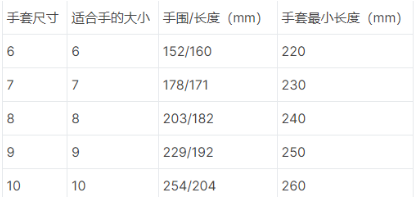
Manual sizing scheme
The new standard does not modify the hand size scheme, and in addition, the new guidelines allow you to use your own hand size system.
In this case, the user guide should include measurements of hand length (distance from wrist to tip of middle finger) and hand circumference.
electrostatic properties
Due to the presence of flammable or explosive substances ( 3 ), it is recommended to use protective gloves in some workplaces that are known to be high-risk.
The electromagnetic properties of these gloves are intended to be tested in accordance with test method EN 16350.
The pictogram (pictogram 2415 of ISO 7000) shall be used as the marking of protective gloves that have been tested and comply with the requirements of EN 16350.
In addition, user instructions and test conditions should be included in the manufacturer’s documentation.
What are the differences between the old and new standards in terms of electrostatic performance?
The main difference between standards is that the electrostatic performance of protective gloves according to EN420:2003 must be checked using test method EN1149.
In addition, these gloves do not have pictograms.
dexterous
Gloves dexterity should be evaluated based on their elasticity, thickness and deformability.
Dexterity is calculated based on the minimum steel needle diameter that can be picked up 3 times in 30 seconds.
If the pin cannot be picked, the level obtained is 0. If necessary, finger flexibility can be tested for specific uses.
Performance level minimum diameter
1 11
2 9.5
3 8
4 6.5
5 5
What is the difference between the old and new standards for glove dexterity?
In the new standard, no new changes have been made.
Water transmission and absorption
In accordance with the Water Vapor Transmission and Absorption Standards (EN 420, 5.3), protective gloves should be able to promote water vapor transmission by allowing sweat to escape from the gloves, thereby improving user comfort.
How to assess water transmission and absorption?
If rubber or polymer gloves are not permeable to water, the test here is irrelevant.
What about other types of gloves?
Other types of gloves test water vapor-transferred air by pinching a sample of material in the mouth of a container containing a solid desiccant and maintaining it in a fast-current condition.
By moving the desiccant, the air in the container circulates. The desiccant absorbs moisture from the air passing through the material, causing an increase in the weight of the container.
Data is in milligrams per second (cm2.h). The specifications stipulate that if required, the material must have a water vapor transmission rate of at least 5mg/m2 (cm2.h).
In addition, when the design and materials of gloves hinder the transmission of water vapor, gloves should be water-absorbent to reduce the impact of sweat.
A material sample was clamped to a water storage tank above the mouth of the sealed container to evaluate this attribute. Throughout the test, water vapor was absorbed from the air in the container and expressed in mg/cm2.
According to EN 420, gloves must have a water vapor absorption rate of at least 8mg/cm2 when tested for 8 hours.
marking
The new standard makes labeling on each protective glove a mandatory requirement.
Since performance levels can change due to aging, the label should indicate the glove’s manufacturing date and expiration date.
 WeChat


 Submission Successful
 WeChat Official Account