-
Xuntong specializes in testing services for electrical accessories, consumer electronics, lighting, wireless, toys and other products.



 Service Hotline 18617145297
In addition to North America and European countries, which are developed regions for international trade, Australia and New Zealand are no exception. Australia and New Zealand refers to Australia and New Zealand, two countries with certain historical origins, consumption habits, purchasing preferences, import product regulations and technical requirements. Coupled with the strong demand for local imports of electronic products, many Australian and New Zealand exporters who want to understand the certification requirements of Australian and New Zealand may wish to start watching the following content:

SAA certification is a standards body of the Standards Association of Australia (SAA) and requires electrical products entering the Australian market to comply with local safety regulations, which is the basic threshold for entering the local market. Due to the mutual recognition agreement between Australia and New Zealand, all products with Australia certification can also be sold in the New Zealand market.
SAA certification consists of two parts: electrical products are divided into prescribed products and non-prescribed products.
(1)The specified products are classified according to AS/NZS4417.2, including electric heating equipment, refrigeration equipment, power tools, power supplies, etc. Require electrical products to obtain a State-issued Certificate of Approval (SAA) regulatory agency and require labeling.
(2) Non-prescription products can be sold without safety certification. Although certification is not mandatory for non-regulated products, exporters/importers are responsible for their safety and can voluntarily apply for certification.
Whether imported products are controlled by the Australia market can be checked through the following link. Electrical products with a basic voltage range of 50V to 1000V AC or 120V to 1500V DC require SAA certification.
https://www.saaapprovals.com.au/regulated-products/
It is stipulated that SAA certification for electrical products is basically applied locally by suppliers from the exporting country, but as an importer, you need to confirm your supplier’s SAA certification qualification in advance. There are currently two forms of SAA: formal recognition and standard certification. Formal recognition is only responsible for samples, while standard recognition requires a review of each factory. If you have a CB or IEC test report, you can directly transfer it to SAA through the CB or IEC test report. If you do not have a CB or IEC, you can also apply directly. Generally speaking, the cycle for applying for SAA certification for common products such as IT, lighting, and small household appliances is 3-4 weeks. If the product quality is unqualified, the cycle for applying for SAA certification will be extended.
SAA certification process:
Fill in the application form → product sample testing → product rectification (if the test fails) → issue a report → evaluate → issue a certificate
In Australia, EMC requirements for electrical products are regulated by the ACA (Australia Communications Authority). In addition to the Australia and New Zealand Standards (AS/NZS), the 2002 ACA also recognized 103 other standards, including EN, IEC and CISPR.
To limit the impact of electromagnetic interference, Australia introduced mandatory electromagnetic interference (EMI) requirements for all products within the scope of the standard since January 1999. Some of the EMC test items that must also meet mandatory requirements are: conducted interference and radiated interference. The remaining EMC projects are not mandatory.
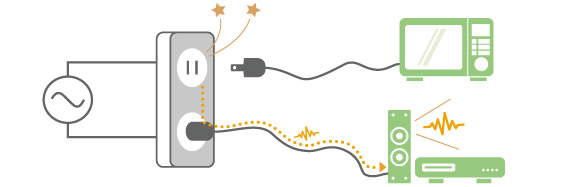
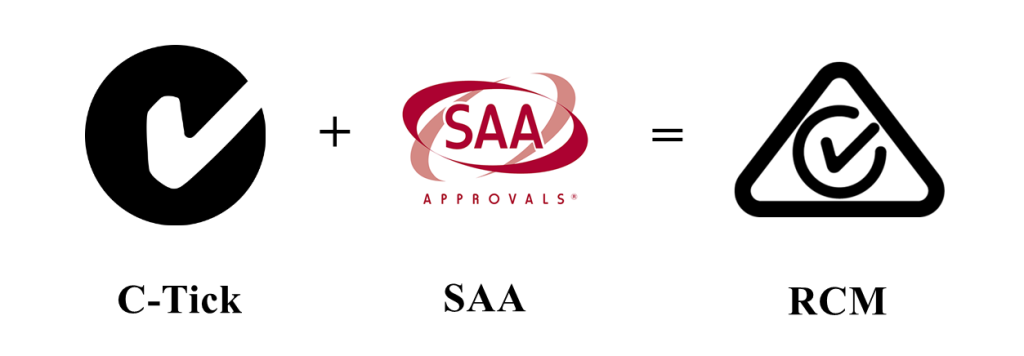
The product has been tested to meet relevant standards, and the report has been submitted by the Australia importer. The C-Tick mark can be added only after the Australia ACA accepts and issues a registration number. The purpose is to protect the resource wireless communication frequency band. However, since Australia enforced RCM, the C-Tick logo is no longer mandatory and has been replaced by the RCM logo. However, even if the C-Tick mark is replaced by the RCM mark, most products still need to complete the C-Tick certification in advance before they can apply for the RCM mark.
The RCM (Regulatory Compliance Mark) is a mark introduced in Australia and New Zealand to achieve uniformity in the marking of electrical products. The mark is a trademark owned by regulatory authorities in Australia and New Zealand and indicates that the supplier declares that the product meets safety and other requirements under electrical safety laws or regulations of the states of Australia and New Zealand, as well as electromagnetic compatibility requirements under the Australia Radio Communications Act and the New Zealand Radio Communications Act. It is a certification system that combines EMC electromagnetic wireless and electrical safety.
Based on the risk level of electronic products, Australia divides electrical products into three risk levels: Level 1 low risk category, Level 2 medium risk category and Level 3 high risk category. Levels 2 and 3 are mandatory for RCM registration and uploading information to the EESS database.
Level 1 certification requirements:Generally refers to products powered by DC (with EMC reports, you can use the RCM mark by yourself)(i.e. C-TICK).
Level 2 certification requirements:Generally refers to AC power supply products (EMC report + safety report) applying for RCM mark +EESS registration (i.e. C-TICK+ safety test report).
Level 3 certification requirements:Refer to the Australia mandatory certification list (providing EMC report +SAA test report +SAA certificate) to apply for RCM certification +EESS registration (i.e. C-TICK+SAA certification).
1.For products with plugs, the SAA certificate of the product plug is required when submitting the report to Australia for review. In addition, the SAA certificate for important internal components of the product, such as the SAA certificate for internal lighting transformers.
2. RCM certification can only be applied by Australia importers, and importers must apply for RCM numbers from the Australia government. Manufacturers and exporters in the country of origin can apply for an IEC or AS/NZS report in their own name, but the report must be submitted to an Australia importer before an RCM can be applied.
3. A service fee is charged for RCM registration. First of all, if you are applying for the first time, you need to register your company. The fee is AUD 208. Then you need to register your product. The fee varies according to the length of registration. AUD 78 for 1 year, AUD 156 for 2 years, AUD 390 for 5 years., the fee may change every year. Importers can check real-time updates on the EESS official website.
4. Level 1 and Level 2 electrical products do not need to apply for SAA certification. Level 1 electrical products do not need to undergo safety testing. Level 2 electrical products only need to undergo safety test reports that comply with Australia standards. Only Level 3 electrical products need to be SAA certification.
Electronic products are a relatively broad product category that contains many different functions and parameters. In actual imports, the market or government requires different testing regulations for products with different categories and parameters. Of course, there may be other certification requirements. Importers can refer to the specific requirements of the local market, consult professional testing agencies, or talk with suppliers with export experience.
 WeChat


 Submission Successful
 WeChat Official Account