-
Xuntong specializes in testing services for electrical accessories, consumer electronics, lighting, wireless, toys and other products.



 Service Hotline 18617145297
On August 8, 2023, the European Union officially announced the Commission Authorization Bill (EU) 2023/1608 of May 30 this year on page 24 of the Legislative Series L198 of its Official Journal. The bill amends Part A of Annex I to the POPs Regulation (EU) 2019/1021-adding the requirements for perfluorohexane sulfonic acid (PFHxS), its salts and PFHxS-related compounds. So far, the list of banned POPs substances has increased from 28 items to 29 items. The requirement will take effect on the 20th day after its publication in the Official Gazette of the European Union.
The specific limit requirements for newly added items are as follows:
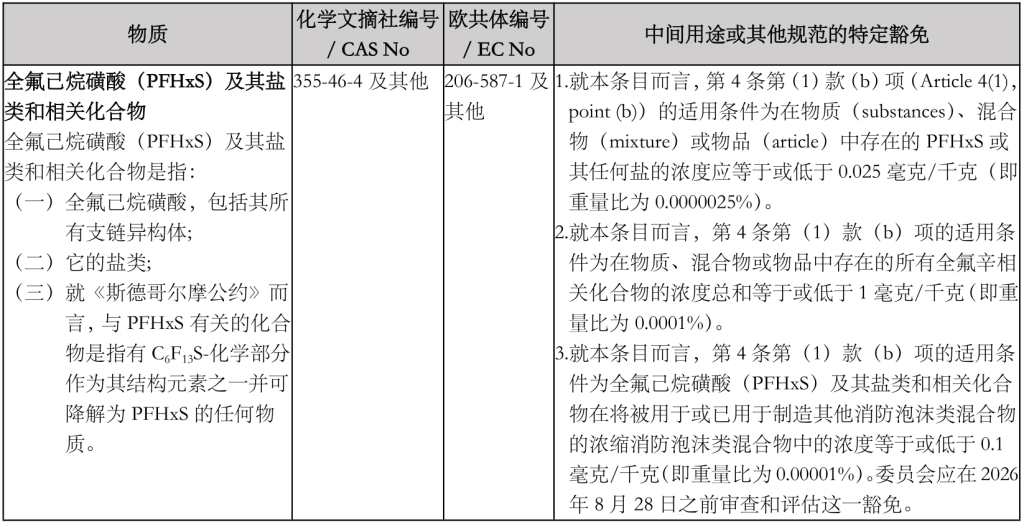
√ Article 4 (1)(b)(Article 4(1), point (b)) refers to trace pollutants that (can be regarded as) unintentional (added) in the substance, mixture or article specified in the entry.
Persistent Organic Pollutants (POPs) are characterized by persistence, accumulation, migration, and high toxicity. They are serious harm to the environment, are highly toxic to aquatic organisms, and will have long-term negative effects on the aquatic environment. The regulation under control is the “Stockholm Convention on Persistent Organic Pollutants”. Currently, 186 countries and regions from around the world have signed the Convention. The EU’s POPs regulations are highly enforced. In recent years, the EU’s non-edible consumer goods rapid warning system Judging from the recall cases of the EU rapid alert system for dangerous non-food products (RAPEX), there are still many products that have been recalled for violating EU POPs regulations. Among them, small household appliances, headphones, etc. have high risks. The main reason for the recall is that the materials contain short-chain chlorinated paraffins (SCCPs) controlled by EU POPs regulations.
Some POPs are often used in electronic and electrical products. For example, in order to meet flame retardant requirements or plastic requirements for processing, substances such as HBCDD and SCCPs may be added to the shell or wire; non-metallic materials are often added for durability or specific purposes. Fluoropolymer materials may be added, resulting in possible containing controlled substances such as PFOS, PFOA and their salts. In order to ensure that such products meet relevant requirements, companies should not only require requirements from the raw material procurement process, but also increase product testing to avoid products being recalled due to non-compliance, causing major losses.
 WeChat


 Submission Successful
 WeChat Official Account