-
Xuntong specializes in testing services for electrical accessories, consumer electronics, lighting, wireless, toys and other products.



 Service Hotline 18617145297
Due to the inconsistent specifications of electronic equipment charging interfaces (each device has its own dedicated charger), this causes inconvenience to users and waste of resources. Therefore, the European Union has long been committed to promoting the unification process of charging interfaces for consumer electronics products, reducing resource waste and promoting the process of green environmental protection. At the same time, the universalization of charging accessories has also brought a better charging experience to consumers.
Therefore, in 2019, the European Union adopted a proposal in the form of the RED Directive (mainly referring to wireless electronic devices, including smartphones, tablets, cameras and other devices that need to be charged using batteries) and decided to unify the charging interfaces of all electronic devices into USB-C. The other intention of the directive is to unify the C port so that chargers and devices will no longer be sold bundled.
On October 24, 2022, the European Council approved the bill to “unify charger interfaces across the EU”. By the end of 2024, the USB Type-C interface will become a common charging standard for a series of electronic devices.
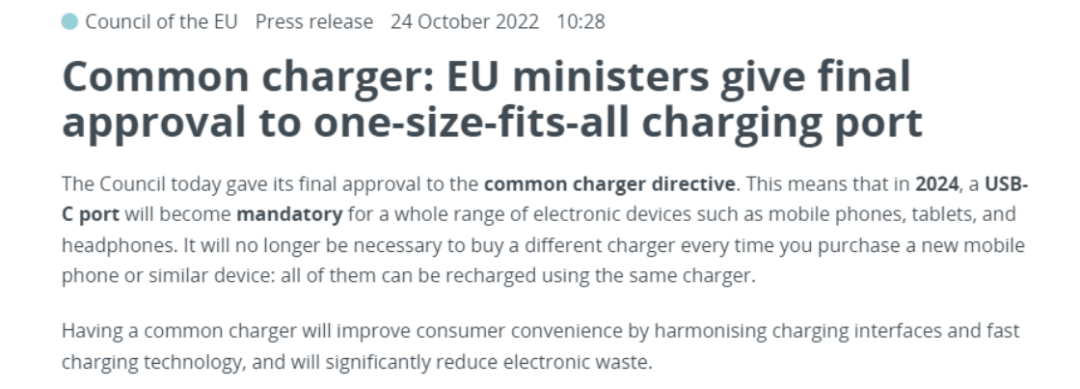
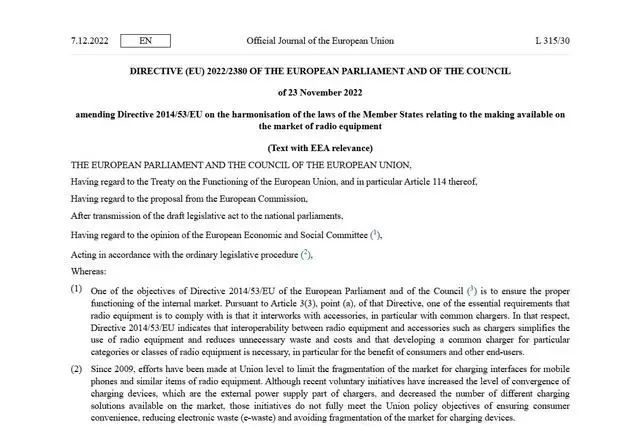
The EU has issued a new Directive EU (2022/2380) to supplement relevant requirements such as charging communication protocols, charging interfaces, and consumer information. This regulation is not only used in a certain country, but is implemented by all EU member states. Products sold in EU member states must comply with its regulations.
Involved equipment scope and execution time
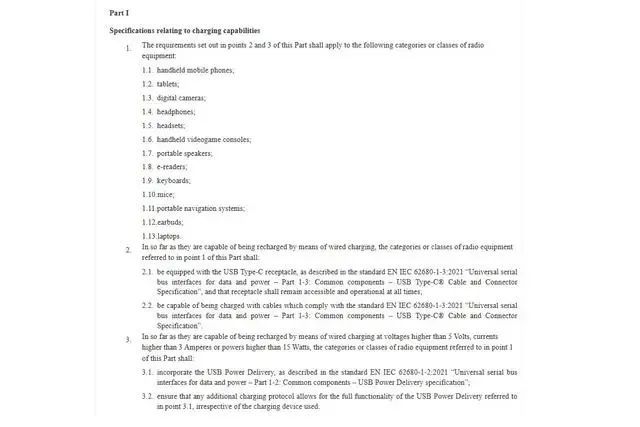
The law applies to 13 types of wireless devices, including newly manufactured mobile phones, tablets, digital cameras, headphones, portable game consoles, portable speakers, e-books, keyboards, mice, navigators, wireless headphones, laptops, etc.
The mandatory implementation date of the revised directive is December 28, 2024 (except for notebook computers, the requirements for notebooks will be relaxed for 2 years, and the implementation date will be April 28, 2026), which means that new equipment entering the EU market after the mandatory date must meet the requirements of the directive.
Regulated electronic products need to be equipped with USB-C interfaces and can be charged using USB-C cables. Both interfaces and cables need to comply with the “EN / IEC 62680-1-3:2021 Part 1-3” standard.
When the charging power of the device is greater than 5V3A (15W), regardless of whether other charging protocols are used, the power supply requirements of the “EN / IEC 62680-1-2:2021 Part 1-2” standard need to be met, that is, USB Power Delivery (USB PD) must be fully supported.
New information label
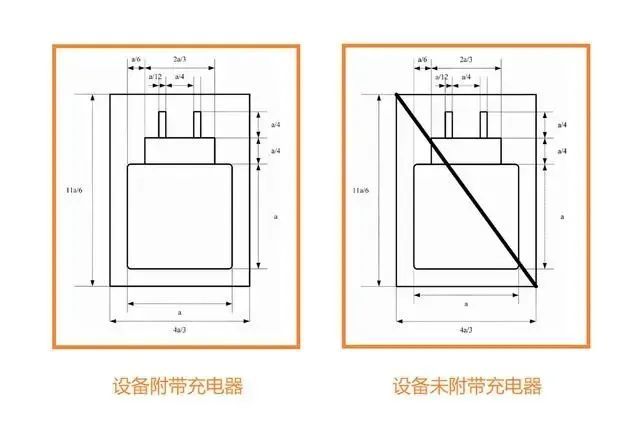
In order to allow consumers to clearly know the charging power specifications of the equipment, all regulated products must display or provide labels, and the label types are as shown in the figure. On the left is the label style when the device comes with a charger, and on the right is the label style when it does not come with a charger.
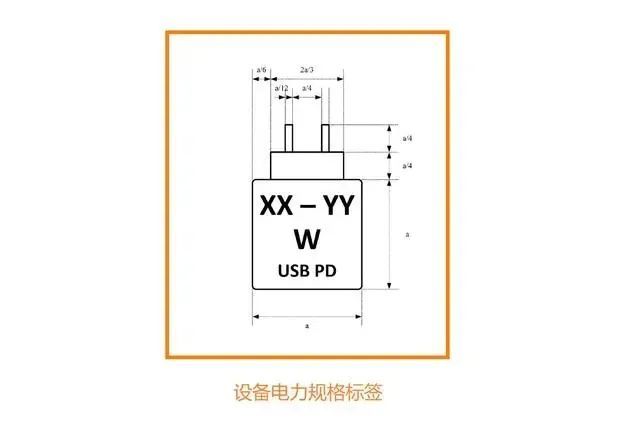
In addition, the power specification of the equipment needs to be printed on the label. XX represents the minimum power specification (watts) required for the equipment to operate, and YY represents the power specification (watts) at which the equipment can achieve the maximum charging speed when operating. If the device supports the USB Power Delivery charging standard, the word “USB PD” will also need to be printed.
 WeChat


 Submission Successful
 WeChat Official Account