-
Xuntong specializes in testing services for electrical accessories, consumer electronics, lighting, wireless, toys and other products.



 Service Hotline 18617145297
In February 2021, the Packaging Toxic Substances Clearinghouse (TPCH) announced the organization’s 2021 update to its Model Toxics in Packaging Legislation. Updates at that time will include the addition of perfluoroalkyl and polyfluoroalkyl substances (PFAS) and ortho-phthalates categories as controlled chemicals, as well as new processes and standards for identifying and regulating other chemicals of high concern in packaging.
Limited by the large and complex quantities of the two new substances, companies lack certain guidance at the compliance enforcement level, and this “Guide” just released (November 2023) will help alleviate this situation.
The “TPCH 2021 Model Legislative Update” guidance provides compliance methods and analytical methods for PFAS substances required by legislation, recommends testing methods for phthalates and provides a batch of lists, and also provides information on production, sales, and compliance parties put forward some requirements and suggestions. The details are as follows:
1. For perfluoroalkyl and polyfluoroalkyl substances (PFAS)
1)Recommendations on compliance methods
a) Consult the manufacturer or supplier whether it has intentionally added PFAS substances
b) Raw material disclosure
√ Require suppliers to disclose all materials
√ When all-material disclosure is not feasible, suppliers are required to at least disclose whether PFAS chemicals have been intentionally added
√ Seek third-party certification for materials
2) Analysis
a) Measure total fluorine content
√ Presumption of compliance: If the total fluorine content of the product is less than 100ppm and the production meets the quality control standards, it can be basically presumed that no PFAS has been intentionally added to the production, and it can be considered to meet the packaging limits of each state.
√ It is recommended to confirm with the supplier the following matters on the premise of satisfying the presumption of compliance:
No intentional additions
Identify unintentional sources of PFAS in order to attempt to reduce or eliminate these sources
When the product contains fluorine, it can be proved that it originates from inorganic fluorine (non-PFAS).
b) Although Total Fluorine (TF) or Total Organic Fluorine (TOF) levels below 100 ppm are often regarded by laboratories and standards bodies as not intentionally adding PFAS to food packaging. However, as long as fluorine is detected, even if the content is below 100ppm, the manufacturer should confirm with its supplier that PFAS has not been intentionally added.
c) With the development of science and cognitive progress, the thresholds mentioned in the above information may be revised.
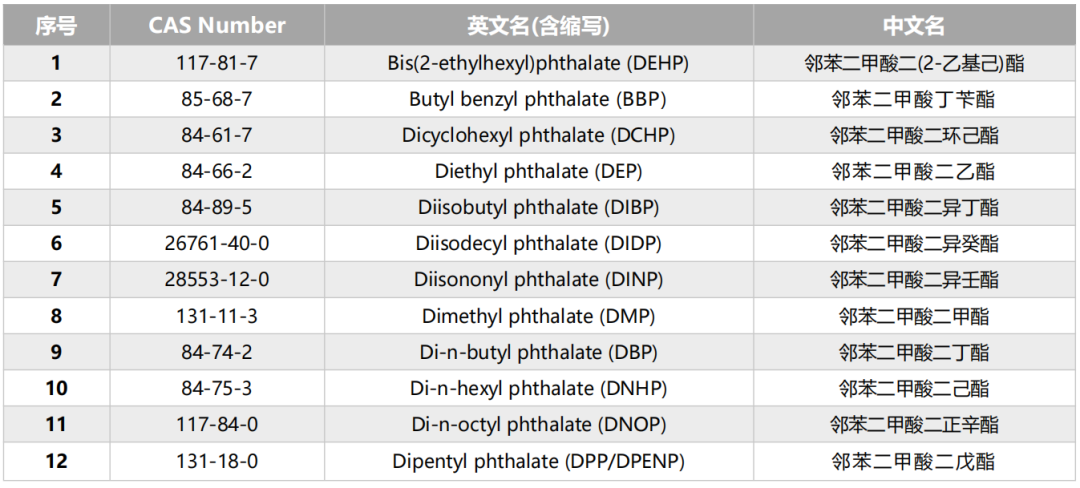
2. Ortho-phthalates are semi-volatile organic compounds.
For packaging materials, it is recommended to use SW846 method 8270 or EPA method 3541. The Guide lists a series of selected phthalates that are commonly determined using the above methods:
III. To-do items for manufacturers, brands and retailers to fulfill their compliance responsibilities
1)All suppliers are required to provide certificates of compliance for all packaging materials and their components in any contract or tender specification.
2)Ask about the criteria used to determine compliance.
3)If the supplier’s material formula changes, information needs to be updated.
4) Prepare your own compliance certificate information based on your packaging supply chain and designate the appropriate authorized signatory.
5) Maintain records indefinitely in accordance with your risk management policies.
4. To-do list for packaging material formulators and suppliers
1)Identify controlled substances in your chemical formulation or the chemical raw materials you provide.
2)Identify controlled chemicals or pollutants that may be added incidentally during the production process.
3)Test baseline information for controlled chemicals or pollutants.
4)All suppliers are required to provide certificates of compliance for all packaging materials and their components in any contract or tender specification.
5)Ask about the criteria used to determine compliance.
6)If the supplier’s material formula changes, information needs to be updated.
7) Prepare your own compliance certificate information based on your packaging supply chain and designate the appropriate authorized signatory.
8) Maintain records indefinitely in accordance with your risk management policies.
 WeChat


 Submission Successful
 WeChat Official Account