-
Xuntong specializes in testing services for electrical accessories, consumer electronics, lighting, wireless, toys and other products.



 Service Hotline 18617145297
After receiving requests from multiple private economic sectors and international organizations to extend the implementation period of the control of hazardous substances in electrical and electronic equipment, SASO decided to extend and initiate mandatory RoHS control for different products in phases on December 16. Starting from January 5, 2022 compared with the original earliest implementation date, buyers will have more time to interpret and coordinate suppliers and sellers during the transition period of this regulation.
Below, we explain SASO’s latest control content on RoHS through three aspects: product range comparison, original and post-stage time, test requirements and precautions.

The above products cover electrical and electronic equipment and spare parts. RoHS regulations ensure product quality and protect the environment and consumer health and safety by determining the percentage of hazardous substances in electronic and electrical equipment and its accessories.
At the SASO Compliance Steering Committee meeting held on December 5, 2021, many private economic sectors and international organizations in the electrical and electronic fields proposed to extend and initiate mandatory RoHS control in the electrical and electronic fields in conjunction with the specific content of RoHS. Different products. The comparison of the time after the extension is as follows, and buyers of relevant products need to pay special attention.
(1) Small household appliances, implemented from January 5, 2022; postponed to July 4, 2022.
(2) Large household appliances, effective from April 3, 2022; postponed until October 2, 2022.
Implementation date is July 1, 2022; postponed to December 31, 2022.
Implementation date is September 27, 2022; postponed to March 31, 2023.
Implementation date is December 25, 2022; postponed to June 29, 2023.
Implementation date is March 23, 2023; postponed to September 27, 2023.
Implementation date is June 19, 2023; postponed to December 26, 2023.
Through the above time comparison, we can see that there is a delay of about 6 months compared with the original implementation time after the extension. As a purchaser, on the one hand, for completed goods that do not comply with the requirements of RoHS regulations, the purchaser needs to complete the sales within this time period. For those with large inventory, it is recommended to take discounts and complete the sales of the batch of goods as soon as possible. On the other hand, on the supply side, new orders need to emphasize product testing requirements to suppliers. If the supplier is unable to meet the demand or price during this process, buy time to negotiate with the supplier or find a supplier that can be used as a backup.
As an importer in Saudi Arabia, you need to understand the testing requirements for RoHS testing, as well as precautions, so that you can better understand the product and correctly review the relevant data after the supplier sends the report.& nbsp;
1. The Saudi test content is basically the same as the six EU RoHS items. You can refer to the following table. The main detected hazards are lead, mercury, cadmium, hexavalent chromium, polybrominated biocene, and polybrominated diphenyl ethers. The maximum allowable sample detection percentage is shown in the table below.
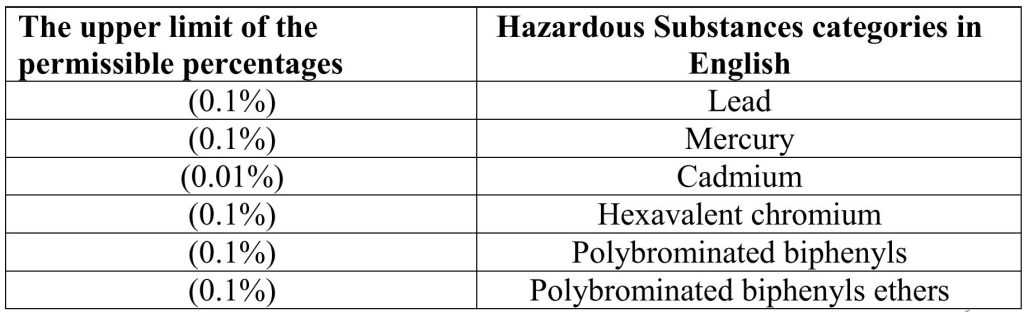
2. Referring to the above test content and data limits, the following points need to be paid attention to in the specific components of the product.
(1)Plastic parts for electronic and electrical products.
Pay attention to the shell, protective door, protective cover shell, switch body, and pressure plate. Most of the materials of these parts are PC, PP, and flame retardant PA66. Pay special attention to whether raw materials comply with RoHS, and whether mixed color powder color plastic parts contain harmful substances exceeding the standard.
(2)Components.
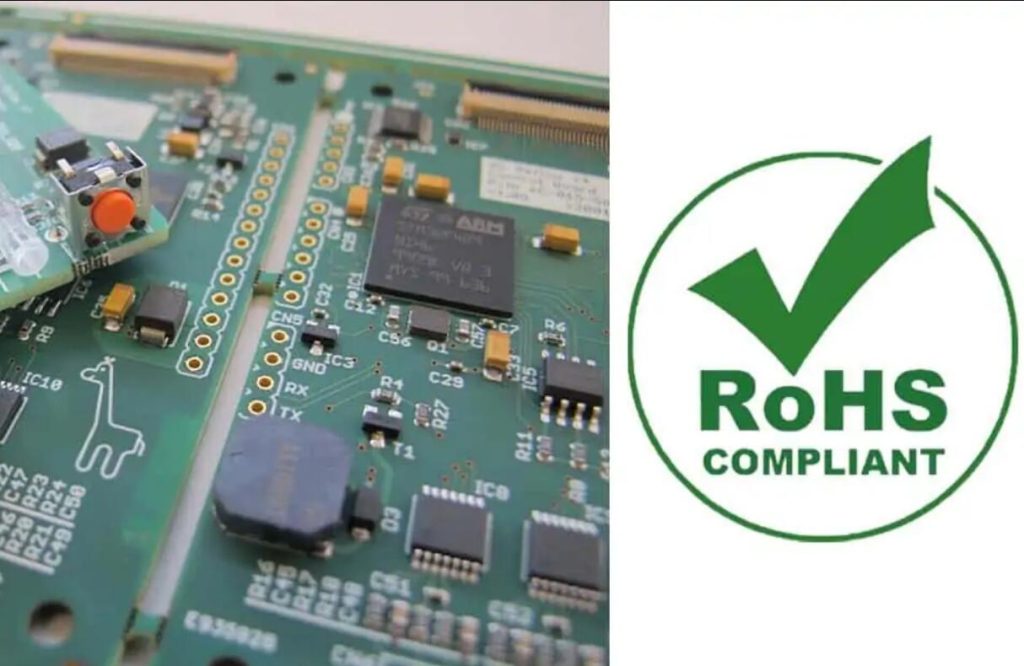
These parts are made of brass, 59 copper and copper. From the purchase of raw materials to the surface treatment, acid cleaning and electroplating of later materials, attention must be paid to the content of harmful substances.
(3)Standard parts.
Standard parts in electronic and electrical appliances, such as some screws, springs, etc., also need to inform suppliers to pay attention to whether the material itself exceeds the standard, and whether harmful substances exceed the standard during post-surface treatment, acid cleaning, and electroplating. Standards.
(4)Packaging.
Product packaging includes stickers, paper cards, inner liners, instructions, color boxes, paper products outer boxes, as well as single and double blisters and PVC boxes made of PVC materials. The final boxed packaging tape is also within the scope. Paper products usually have a large amount of printed content, and both printing ink components and surface bonding materials involve the risk of excessive harmful substances.
3. The laboratory will issue a test report after the test is completed. As a buyer, when you receive a supplier’s test report, you need to check it from the following points.
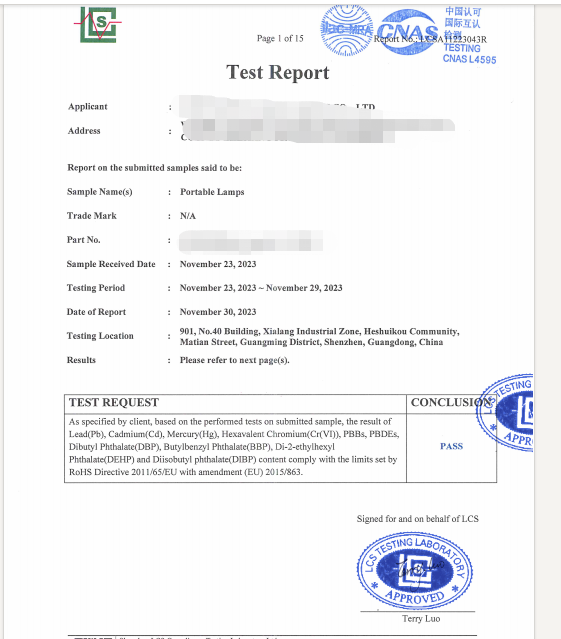
(1) Check whether the institution issuing the report is authoritative.
Testing institutions will generally be displayed at the beginning of the report, such as LCS, SGS, TUV, QIMA, etc.
(2)Look at the report number.
In the same report, no matter how many pages there are, the report numbers should be the same. If the numbers are different, the authenticity of the report is questionable.
(3)Check the report date.
The RoHS report is valid for one year. If the report provided by the supplier is out of date, it has no practical significance.
(4)Check the company name and address of the testing unit.
This is easy to understand. If the supplier takes someone else’s certificate, the report becomes meaningless.
(5)Check whether the test items, values and results are PASS.
(6) Check whether there is a signature and seal by the person in charge of the testing unit.
 WeChat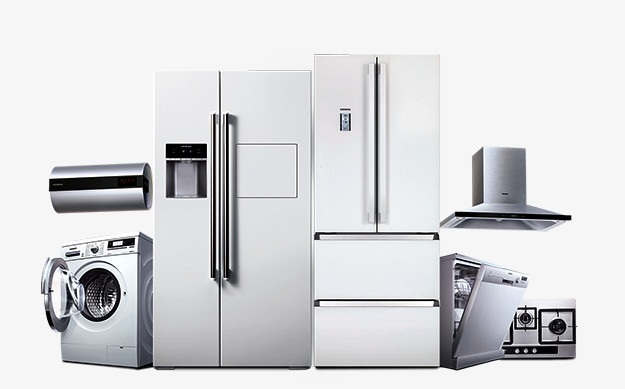


 Submission Successful
 WeChat Official Account