-
Xuntong specializes in testing services for electrical accessories, consumer electronics, lighting, wireless, toys and other products.



 Service Hotline 18617145297
On September 1, 2023, the European Chemicals Agency (ECHA) issued an invitation to the public for comment on 6 of the 14 intentions previously listed as Substances of Very High Concern (SVHCs), which became Identification Ongoing Substances. The review deadline is 23:59 on October 16, 2023, Helsinki Time (EET). During this period, various stakeholders can submit comments on these substances to the ECHA.
Dibutyl phthalate (DBP) among the six reviewed substances was reviewed this time for the hazards of its endocrine disrupting properties to the environment-in fact, it was added to the official list of SVHC on October 28, 2008 due to Toxic for reproduction and the hazards of endocrine disrupting properties to human health. This review is to expand its scope of hazards.
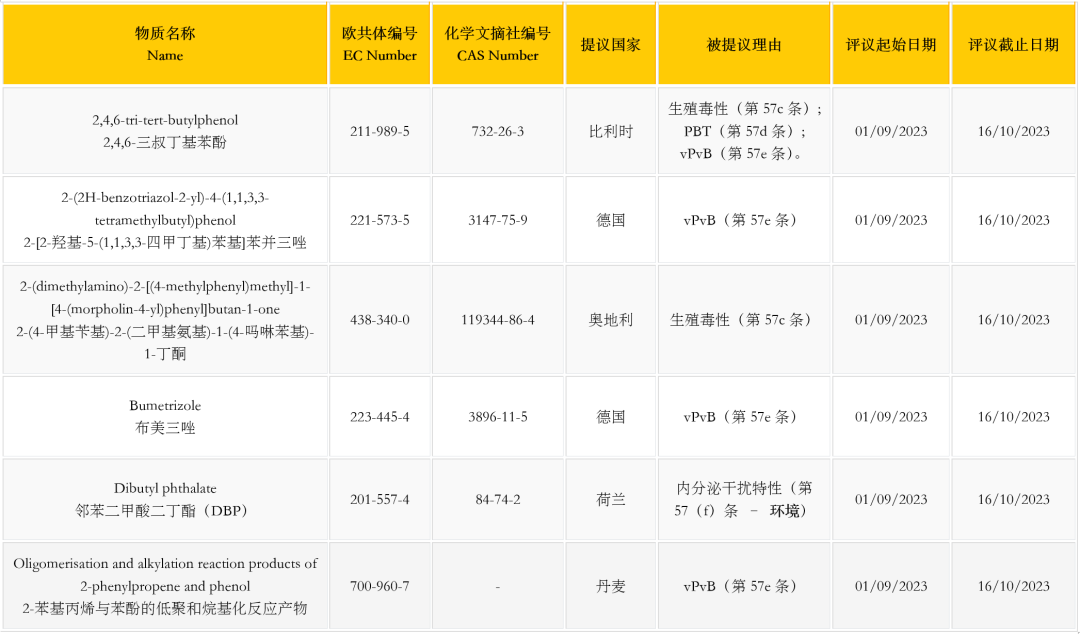
Note:
①PBT substances refer to chemical substances that are persistent, bioaccumulation and toxic.
②vPvB substances refer to chemical substances that are very persistent and Very bioaccumulative.
③ The persistence and bioaccumulation of such substances is reflected in the fact that they are not easy to decompose in both the environment and the biological chain, allowing them to be transported over long distances. Global cooperation is needed to solve the harm of such substances.
Supplementary information:
Basic process for determining SVHC substances:

SVHCs are short for Substances of Very High Concern, substances that may have serious and often irreversible effects on human health and the environment. If a substance is identified as SVHC, it will be added to the Candidate List and may eventually be included in the ANNEX XIV to REACH.
LCS Recommendations (Tips):
With the goal of protecting human health and the environment, ECHA is committed to the safe use of chemicals and encourages industry to develop safer alternatives. ECHA also shoulders the mission of enhancing the competitiveness of European chemicals, and urges relevant companies to comply with regulatory requirements and fulfill regulatory obligations through various policies and penalties.
REACH regulations stipulate that when the SVHC content in articles supplied on the EU market is greater than 0.1% by weight (w/w), information must be transmitted within the supply chain; when the SVHC content in articles is greater than 0.1% by weight (w/w) and the annual export volume is greater than 1 ton, a notification must be made to ECHA.
According to the requirements of the Waste Framework Directive (WFD), starting from January 5, 2021, companies that supply items containing substances of high concern on the candidate list and greater than 0.1% by weight (w/w) on the EU market must submit information on these items to the SCIP (Substances of Concern In Articles as such or in Complex Objects (Products)) database, that is, submit SCIP notification. Please note that the SCIP notification does not require annual export volume to exceed 1 ton.
The SVHC list is generally updated twice a year-once at the beginning of the year and once in the middle of the year. The SVHC list contains more and more types of substances-currently there are 235 official substances. At present, enterprises are facing more and more strict controls. It is recommended that enterprises planning to export products to Europe conduct supply chain inspections and supervision to reduce their own risks and improve their competitiveness in the market.
 WeChat


 Submission Successful
 WeChat Official Account