-
Xuntong specializes in testing services for electrical accessories, consumer electronics, lighting, wireless, toys and other products.



 Service Hotline 18617145297
What is the UN38.3 test report
The UN38.3 test report is a formal certificate that the target battery has accepted all required test items, from T1 to T8 UN38.3 standards.
In China, when transporting lithium batteries or cargo containing lithium batteries on an aircraft or ship, mandatory documents must be submitted to the relevant authorities.
It generally consists of the following nine parts:
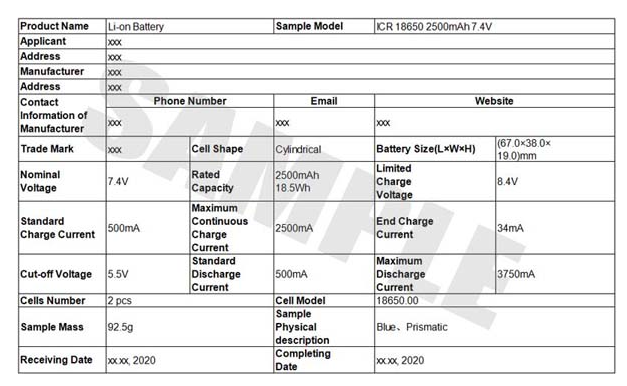
A sample report
It covers comprehensive information including sample name, model number, applicant, manufacturer, normal voltage, rated capacity, limited charge voltage, charge current, maximum continuous charge current, end charge current, cutoff voltage, maximum discharge current, etc.
II. standard
United Nations Recommendations on the Transport of Dangerous Goods, Manual of Tests and Criteria (ST/SG/AC). 10/11/Rev.6/DECd.1 Section 38.3)
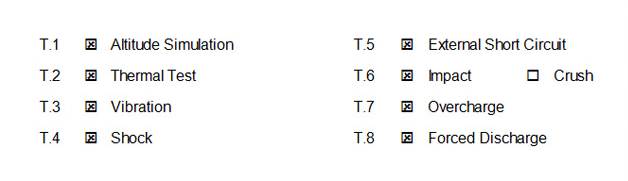
III. test project
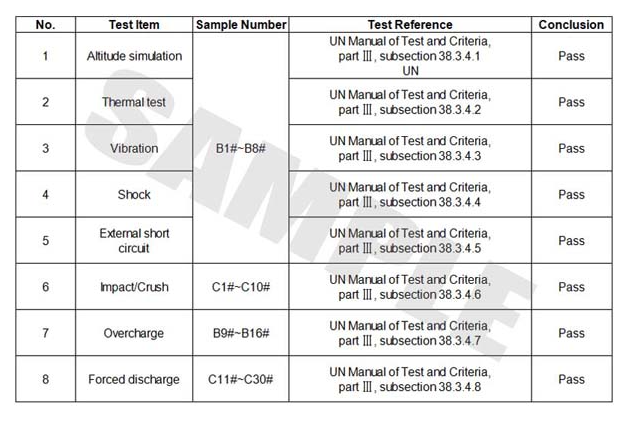
A total of eight test items are listed here. Please note that the impact test and forced discharge test apply to lithium batteries, not lithium batteries.
IV. test methods and requirements
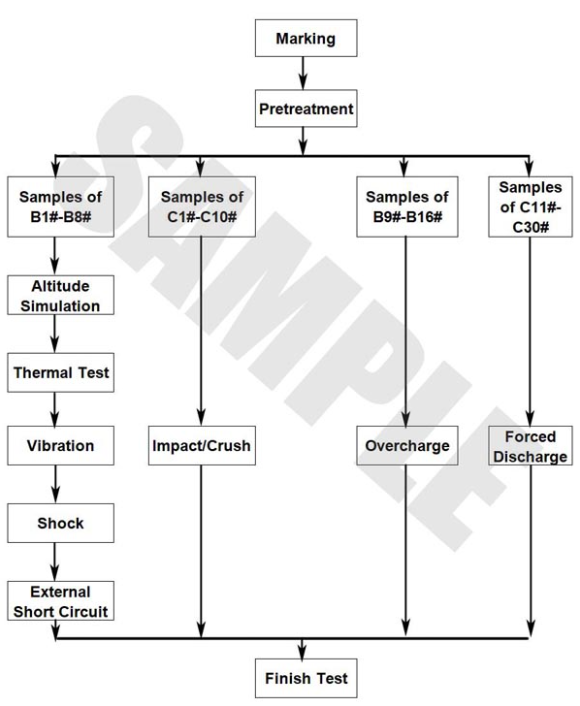
Tests from T.1 to T.5 shall be performed on the same battery or battery.
Tests T.6 and T.8 shall be carried out using untested batteries.
Test T.7 Cyclic battery tests may be performed using undamaged cells used in previous tests T.1 to T.5.
Batteries from B1 #to B4 #and B9 #to B12 #are charged after one cycle;
Batteries from B5 #to B8 #and B13 #to B16 #will be charged after 25 cycles;
Component batteries from C1 #to C5 #are charged 50% after one cycle;
Component batteries from C6 #to C10 #are charged 50% after 25 cycles;
Component batteries from C11 #to C20 #were all released after one cycle;
Component batteries from C21 #to C30 #were all released after 25 cycles;
Test environmental conditions: ambient temperature:15-25C, ambient humidity:40-70%.
To quantify the quality loss, the following formula is provided:
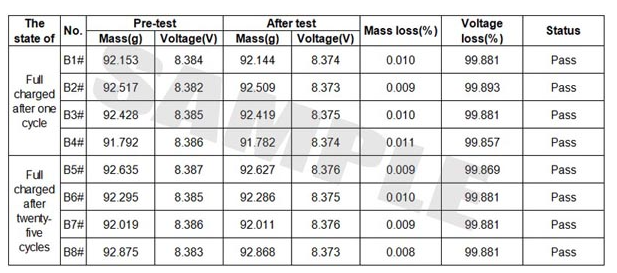
Mass loss(%)=(M1-M2)/M1*100
where is
M1 is the quality before testing
M2 is the quality after testing.
When the quality loss does not exceed the value in the table, it should be considered as no quality loss.
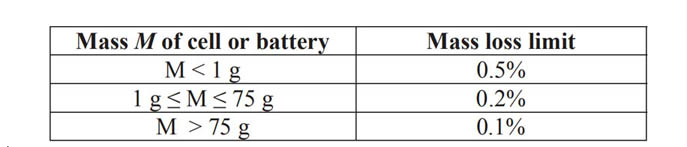
More detailed test methods and requirements, including T.1 to T.8, are also listed here.
v. test flow
vi. Main test equipment
This section includes the names of all instruments used during testing. Core test equipment will be displayed in the report.
VII. test data
The required T.1-T.8 test data are listed separately. The following figure shows an example format of the T.1 height simulation test:
VIII. conclusion
IX. sample picture

 WeChat


 Submission Successful
 WeChat Official Account