-
Xuntong specializes in testing services for electrical accessories, consumer electronics, lighting, wireless, toys and other products.



 Service Hotline 18617145297
Citation standards:
GB/T 33721-2017 Reliability test method for LED lamps.
Lamp type:
1. Outdoor pole mounted lamps (1.5G or 3G vibration)
2. Other lamps
1. Outdoor pole installation lamps
The severity is selected according to the material used in the lamp, Table 6 or Table 7.
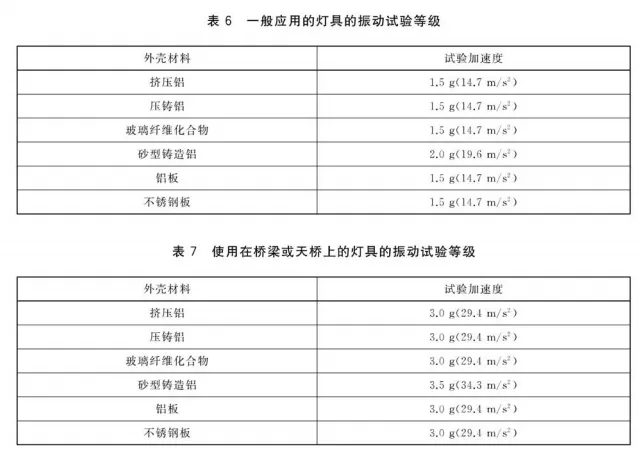
Vibration severity selection: Select a severity level of 1.5G (Table 6) or 3G vibration (Table 7) based on the range of use and materials of the product.
The test steps are two steps:
Test step 1: Resonance frequency search (find resonance frequency points on each axis of X, Y, Z)
√ Frequency range (Hz):2-30;
√ Acceleration (g):0.2;
√ Sweeping rate (oct/min):1;
√ Test axis:X,Y,Z.
That is, before carrying out the endurance test, the resonance frequency points of the lamp in three axes (X/Y/Z) are searched for at an acceleration of 0.2g and a sweep rate of 1oct/min within the frequency range of 2 to 30Hz. (If there is no resonance frequency point, select 30Hz for resonance endurance test)
Test step 2: Durability test (1.5G or 3G)
Vibration endurance is 100000 times (10000 times of fixed frequency endurance test is conducted at the resonance frequency point of each axis);
√ Test frequency: the resonance frequency measured in step 1; if there is no resonance frequency, the test is carried out at 30Hz;
√ Acceleration: 1.5G or 3G;
√ Test times: 100000 times;
√ Test time T=N/60f N is the number of tests, and f is the test frequency.
Number of samples tested: One sample tests three axes; it can also be 3 samples, each sample corresponds to one axis tested.
Test duration: 1 day.
Test fixture: Unless the sample has a very special shape, the laboratory can provide shared fixtures for free.
Test chart display: Y axis (X and Z axes are similar)
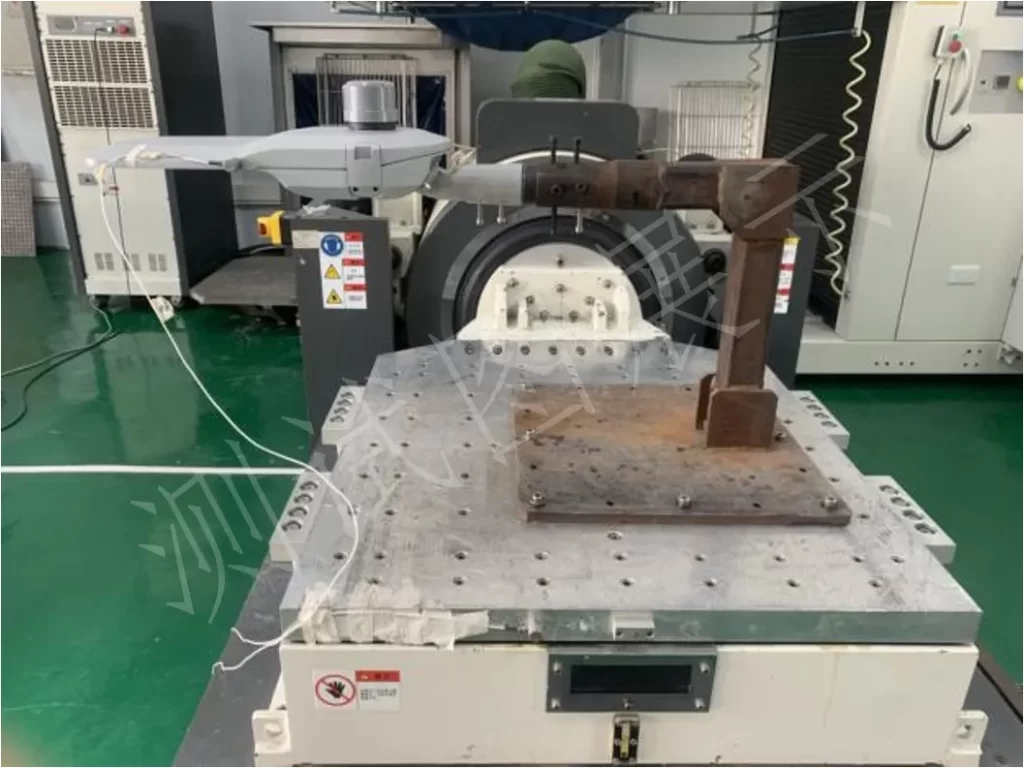
Test curve display: Y axis (X and Z axes are similar)

Test step 1: Resonance frequency point search
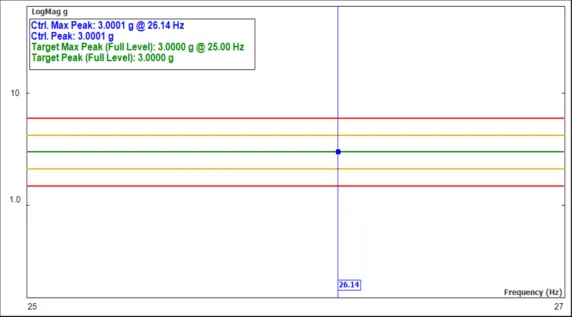
Test Step 2: Durability of 100000 fixed-frequency vibrations
2. Other lamps:
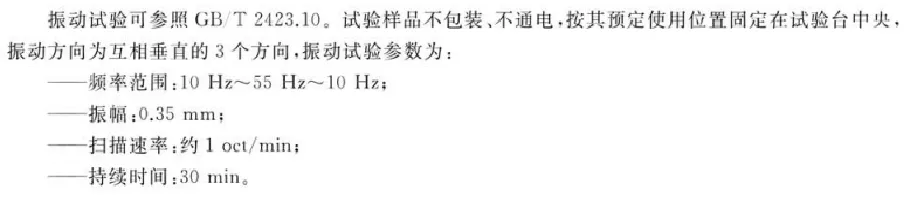
qualification determination
√ Lamps should not show signs of fatigue cracking or structural failure;
√ The housing should not be structurally damaged, electrical spacing reduced, or any part of the lamp should be loose;
√ Any damage that may cause safety problems is equivalent to a test failure;
√ If necessary, the torque of the lamp bolt can be measured, and the residual torque after each axis test must not be less than 70% of the initial torque;
√ If necessary, after each axis test is completed, search for the resonance frequency point of the lamp again. The resonance frequency point after the test cannot exceed 10% of the initial resonance frequency point;
√ After the test is completed, the lamp is powered on and should light up normally.
 WeChat


 Submission Successful
 WeChat Official Account