-
Xuntong specializes in testing services for electrical accessories, consumer electronics, lighting, wireless, toys and other products.



 Service Hotline 18617145297
As a joint national standard between the United States and Canada, UL 1973 has a very high degree of recognition in the field of energy storage. This standard update involves a number of major changes, including: cell test and evaluation, battery system test and evaluation, functional safety assessment, new EMC requirements, and new product test and evaluation methods such as metal-air batteries and sodium-ion batteries. The new version of the standard comprehensively upgrades the safety requirements for energy storage batteries, further increasing the market entry threshold for energy storage products in North America.
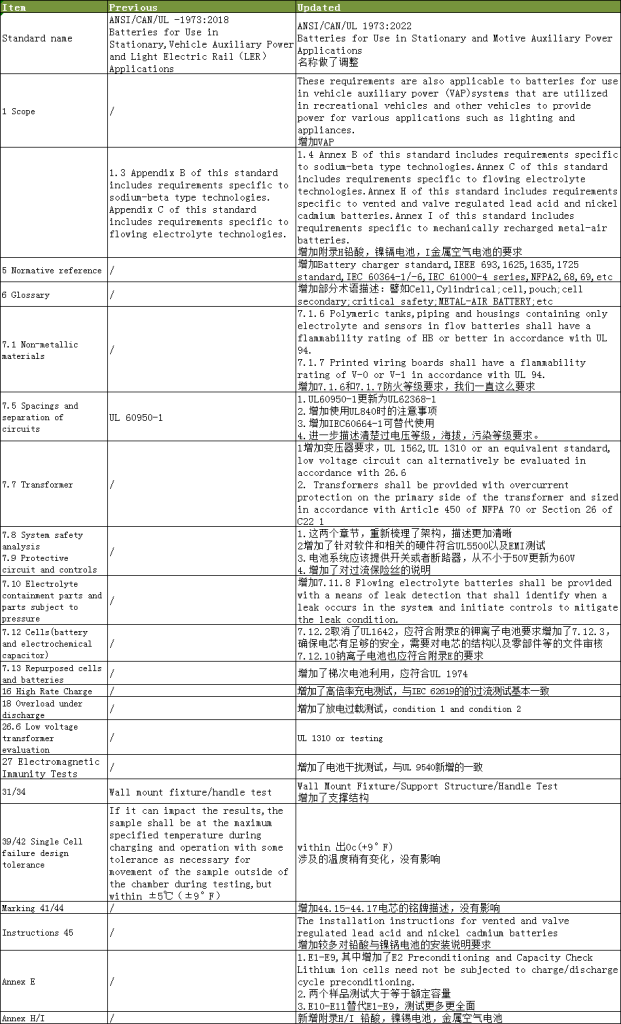
On February 25, 2022, a new version of UL1973 was officially released, and the content has been significantly updated. The interpretation of the standard and the comparison between the old and new editions are as follows:
Main impact:
7.5 Spacings and separation of circuits provides a more detailed explanation, and we have always followed this requirement
7.7 Transformer adds requirements for transformers and may require random testing
16HighRateCharge, basically consistent with IEC62619 testing
18Overloadunderdischarge
27EMI:IEC61000- 4 series is consistent with UL9540 requirements
AnnexE: Cancel UL1642 difference test, Appendix E has two options, increase capacity confirmation
Some precautions for UL1973 certification:
1. The plastic shell must meet a combustion rating of 5VA and an RTI (Impact) impact temperature rating of ≥80℃. The outdoor area must also meet the corresponding UV (ultraviolet resistance) level and waterproof level; if the metal shell needs to meet the anti-corrosion requirements.
2. Insulation materials that come into direct contact with live parts must meet the insulation requirements of UL746C (CTI,IPT,HAI,HWI,RTI).
3. In addition to reliable fixing, the connecting terminals must also be prevented from short circuits, accidental disconnection or reverse connection and must withstand a thrust force of 10N.
4. The junction box meets the wiring space requirements of NFPA70 Table 312.6 (A) or (B); the electrical parameters of terminals and cables must be 125% or greater than or equal to the electrical parameters of the product.
5. Cooling systems require containers to be corrosion-resistant and pass UL157 testing; hazardous material containers or high pressure containers comply with ASME B31.3; when the cooling system fails, no danger occurs; reasonable wiring to prevent liquid leakage to live parts.
6. Electrical spacing complies with Table 5.1, UL60950-1, UL840.
7. Insulation level and grounding requirements: Double insulation/reinforced insulation/basic insulation and grounded; grounding impedance needs to be less than 0.1Ω.
8. Batteries installed in circuits ≥50V must be equipped with a manual disconnect device.
9. Electronic protection lines need to be evaluated for functional safety and meet the requirements of UL991 and UL1998, or IEC61508
10. System safety analysis considers a single fault in the protection line.
11. Critical components need to meet UL certification and usually include: batteries, cables, connectors, fuses and bases, PWBs, seals and labels.
 WeChat


 Submission Successful
 WeChat Official Account