-
Xuntong specializes in testing services for electrical accessories, consumer electronics, lighting, wireless, toys and other products.



 Service Hotline 18617145297
In September 2023, the National Health Commission and the State Administration for Market Regulation jointly issued Announcement No. 6 of 2023, issuing 85 new national food safety standards and 3 amendment orders. Among them, 17 standards involve food-contact materials, including 5 product standards (plastics, metals, rubber, composite materials, inks) and 12 method standards (general rules for migration, general rules for method verification, specific migration test methods, etc.). This article will introduce the GB 4806.7-2023 “National Food Safety Standards Plastic Materials and Products for Food Contact” standard, which is an integrated revision of “National Food Safety Standards Plastic Resins for Food Contact”(GB 4806.6-2016) and “National Food Safety Standard Plastic Materials and Products for Food Contact”(GB4806.7-2016). This standard will be implemented on September 6, 2024.
1. scope of application
Resins, resin blends, plastic materials (various plastic particles, slices, masterbatch, sheets), plastic products. Including unvulcanized thermoplastic elastomer materials and articles.
It is also suitable for starch-based plastic (starch content>40%) materials and products used in food contact.
2. basic requirements
Plastic materials and products used in contact with food shall comply with the provisions of GB 4806.1
3. technical requirements
3.1
01
raw material requirements
02
Environmental protection, the full name of environmental protection, refers to the general term of various actions taken by humans to solve actual or potential environmental problems, coordinate the relationship between humans and the environment, and ensure sustainable economic and social development.
03
Environmental protection, the full name of environmental protection, refers to the general term of various actions taken by humans to solve actual or potential environmental problems, coordinate the relationship between humans and the environment, and ensure sustainable economic and social development.
raw material requirements
The use of resin shall comply with the provisions of Appendix A and relevant announcements;
The use of additives (including vegetable fiber fillers) shall comply with the provisions of GB 9685 and related announcements;
The starch used should be edible starch or modified starch. The edible starch should comply with the provisions of GB 31637. The modified starch should be the variety approved for use in GB 2760 and relevant announcements, and its quality specifications should comply with the provisions of corresponding national safety standards.
3.2
sensory requirements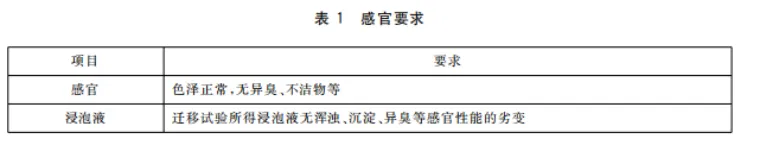
3.3
Physical and chemical indicator requirements
3.3.1 Requirements for general physical and chemical indicators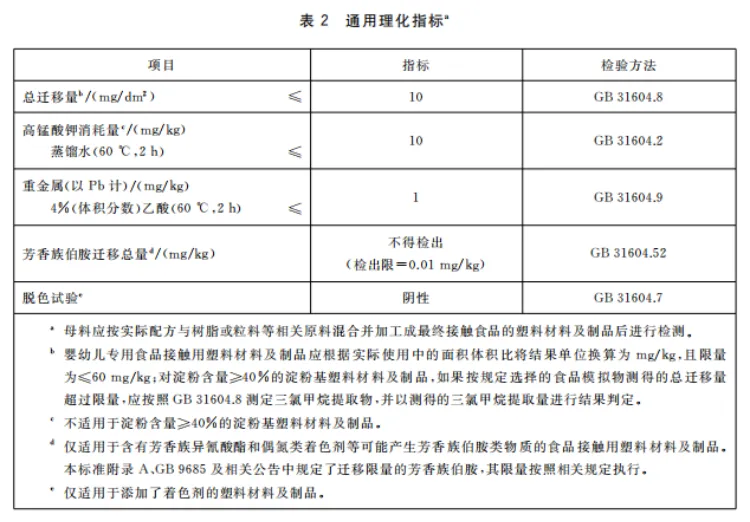
3.3.2 Other physical and chemical indicator requirements
Comply with the provisions of Annex A and relevant announcements on physical and chemical indicators such as the specific migration limit (SML), specific migration total limit (SML(T)), and maximum residue (QM) of monomers and other starting materials of the plastic resin used;
Comply with the provisions of GB 9685 and related announcements on SML, SML(T), QM and other physical and chemical indicators of additives used.
3.4
other technical requirements
Plastic materials and products used in food contact using materials such as coatings, inks and/or adhesives shall also comply with the provisions of corresponding national food safety standards such as coatings, inks and/or adhesives.
4. other
4.1
migration test
It shall be implemented in accordance with the provisions of GB 31604.1 and GB 5009.156, unless there are special provisions in this standard.
4.2
tag identification
Shall comply with the provisions of 4806.1
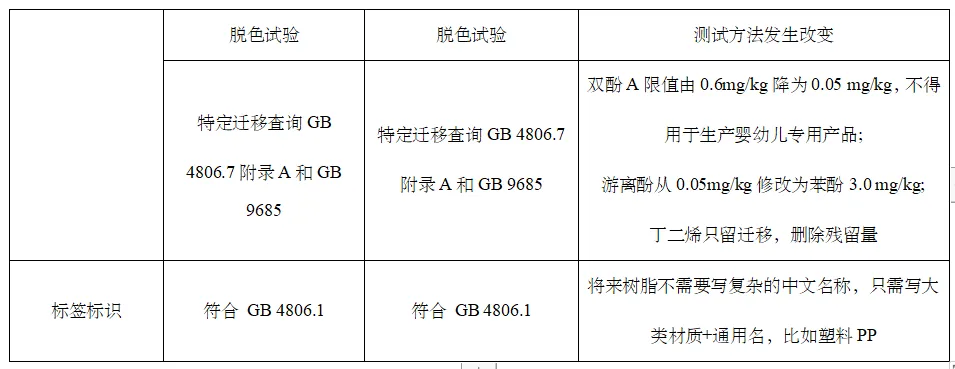
5. summary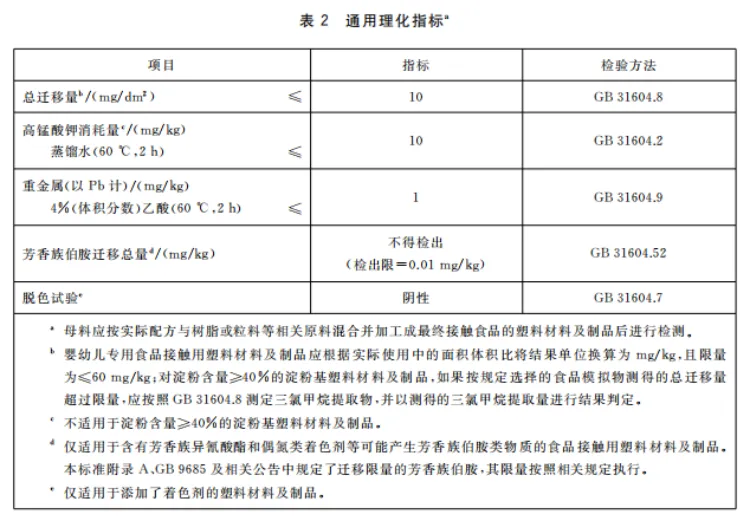
LCS Recommendations (Tips):
Faced with the update of standards, it is recommended that relevant institutions and enterprises learn and understand them in a timely manner, organize and carry out compliance management in accordance with the new requirements, and ensure that production, products and related technical activities meet the requirements of the newly revised food safety standards. The new standard clarifies the ownership and control requirements for starch-based plastics and plant fiber plastics. It is recommended that enterprises containing plant fibers should ensure that the additives such as plant fiber fillers used comply with the provisions of GB 9685 and related announcements. In addition, the new standard applies to plastic materials containing aromatic isocyanates and azo colorants that may produce aromatic primary amines. Materials and products, add new requirements for the total amount of aromatic primary amines migration. It is recommended that enterprises should minimize the use of such substances during the research and development stage and conduct compliance verification as soon as possible.
 WeChat


 Submission Successful
 WeChat Official Account