-
Xuntong specializes in testing services for electrical accessories, consumer electronics, lighting, wireless, toys and other products.



 Service Hotline 18617145297
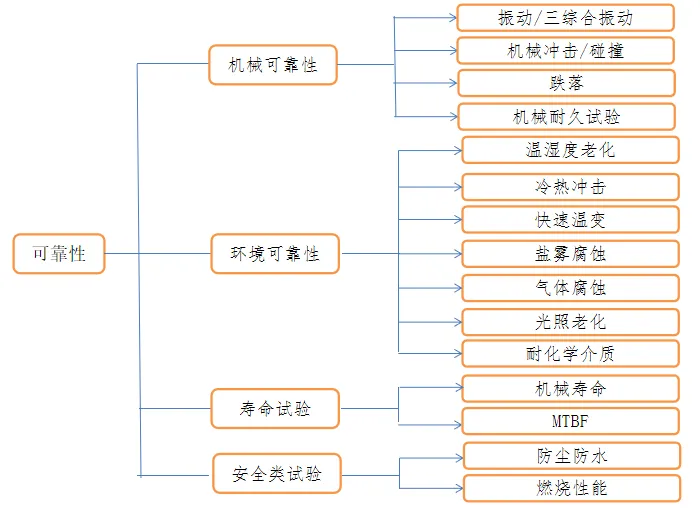
Background introduction to reliability testing
Tests carried out to determine, verify or improve product reliability are called reliability tests and are an important part of product reliability work
Generally, the purposes of product reliability testing are as follows:
(1)Make the product reach predetermined reliability indicators during the development stage. In order to enable the product to meet the predetermined reliability indicators, it is necessary to conduct reliability tests on the samples during the development stage to find out the problems existing in the product in terms of raw materials, structure, process, environmental adaptability, etc., and improve them. After repeated testing and improvement, the reliability indicators of the product can be continuously improved to meet the predetermined requirements.
(2)Conduct reliability appraisal during product development and finalization. When developing and finalizing new products, identification tests must be carried out according to product standards (or product technical conditions) to comprehensively assess whether the product meets the specified reliability indicators.
(3)Control product quality during production. In order to stably produce products, it is sometimes necessary to conduct reliability tests on items specified in product technical conditions for each product. In addition, reliability sampling tests need to be carried out batch by batch or within a certain period of time. Through product reliability testing, we can understand the stability of product quality. If product quality declines due to reasons such as poor quality of raw materials or out-of-control process, it will be reflected in the product reliability test, so that corrective measures can be taken in time to return product quality to normal.
(4)Products are screened to improve the reliability level of the entire batch. Reasonable screening can eliminate products that fail early due to various reasons (such as defective raw materials, improper process measures, operator negligence, production equipment failures, and lax quality inspections), thereby improving the reliability of the entire batch of products. level.
(5)Study the failure mechanism of the product. Through product reliability tests (including simulation tests and field use tests), we can understand the failure modes and failure laws of products under different environments and different stress conditions. Through the analysis of failed products, we can find out the intrinsic causes of product failure (i.e. failure mechanism) and weak links of the product, so that corresponding measures can be taken to improve the reliability level of the product.
Climate and environment testing:
| test project | reference standard | capabilities |
| low temperature test | GB/T 2423.1-2008; IEC 60068-2-1: 2007EN 60068-2-1: 2007 | -40℃,1m×1m×1m |
| high temperature test | GB/T 2423.2-2008; IEC 60068-2-2: 2007EN 60068-2-2: 2007 | +150℃,0.5m3 |
| constant damp heat test | GB/T 2423.3-2016; IEC 60068-2-78: 2012EN 60068-2-78: 2013 | Temperature range: -40℃~150℃ Humidity range: 20%RH~98%RH; 1m × 1m × 1m |
| alternating damp heat test | GB/T 2423.4-2008; IEC 60068-2-30: 2005EN 60068-2-30: 2005GB/T 2423.34-2012; IEC 60068-2-38: 2009EN 60068-2-38: 2009 | Temperature range: -40℃~150℃; Humidity range: 20%RH~98%RH; 1m × 1m × 1m |
| salt spray test | GB/T 2423.17-2008; IEC 60068-2-11:1981EN 60068-2-11:1999 | Equipment capacity: 90L |
| IP rating (waterproof and dustproof test) | GB/T 4208-2017IEC 60529-1989+Amd 1-1999+Amd 2-2013+Cor 2- | IPX1~IPX8; IP1X~IP6X |
Mechanical testing:
| test project | reference standard | capabilities |
| vibration test | GB/T 2423.10-2008; IEC 60068-2-6: 2007EN 60068-2-6: 2008; GB/T 2423.56-2006IEC 60068-2-64: 2008;EN 60068-2-64: 2008 | Maximum thrust: 3kN; maximum acceleration: 1000m/s2Frequency range: 5Hz~2000Hz; Maximum displacement: 25mm Maximum table load: 120kg |
| mechanical shock test | GB/T 2423.5-1995; IEC 60068-2-27: 2008EN 60068-2-27: 2009 | Half sine wave; impact acceleration range: 150~15000m/s2Pulse duration: 0.5~18ms; maximum load of table: 5kg workbench size: 200×200mm |
| drop test | GB/T 2423.8-1995; IEC 60068-2-31: 2008EN 60068-2-31: 2008 | Falling height: 30~150cm; maximum load of table top: 70kg |
| IK test (level of protection of the housing against external mechanical impacts) | GB/T 20138-2006; IEC 62262: 2002EN 62262: 2002 | Impact energy: 5J, 10J, 20J |
Combustion testing:
| test project | reference standard |
| glow-wire test | GB/T 5169.10-2006; GB/T 5169.11-2006; GB/T 5169.12-2013; GB/T 5169.13-2006IEC 60695-2-10:2013; IEC 60695-2-11:2014IEC 60695-2-12:2010+A1: 2014; IEC 60695-2-13:2010+A1: 2014EN 60695-2-10:2013; EN 60695-2-11:2014EN 60695-2-12:2010+A1: 2014; EN 60695-2-13:2010+A1: 2013 |
| needle-flame test | GB/T 5169.5-2008; GB/T 5169.16-2008; GB/T 5169.17-2008IEC 60695-11-5:2016; IEC 60695-11-10: 2013; IEC 60695-11-20: 2015EN 60695-11-5: 2017; EN 60695-11-10:2013; EN 60695-11-20:2015 |
| leakage tracing test | GB/T 4207-2012; IEC 60112:2003+A1: 2009; EN 60112:2003+A1: 2009 |
| horizontal combustion test | UL94; GB/T 2408-2008 |
| vertical burning test | UL94; GB/T 2408-2008 |
Other tests:
| test project | reference standard |
| withstand voltage test | GB/T 1408.1-2016; ASTM D149-2009(2013); IEC 61180-1-2010; GB/T 17627.1-1998 |
| roller drop test | GB/T 2423.8-1995; IEC 60068-2-32-2007 |
| wire bending test | IEC 60335-1-2010/Amd 2-2016/Cor 1-2016; GB/T 2099.1-2008 |
| ball pressure test | GB/T 5169.21-2006; IEC 60695-10-2: 2014; EN 60695-10-2:2014 |
| temperature rise test | Standards by enterprise |
| Chemical reagent resistance test | Standards by enterprise |
| plug-in test | Standards by enterprise |
IT products and their surroundings: Mobile phones, tablets, walkie-talkies, mice, keyboards, stereos, etc.;
Wearable electronic products: Headphones/Bluetooth headphones, smart watches/bracelets, VR glasses, etc.;
vehicle-mounted electronic product: Car navigation, driving recorder, car camera, T-box, dashboard, car charger, car display, car lights, window control system, central control, etc.;
electronic components: Resistance, inductance, capacitor, PCB, etc.;
home electronics: Cameras, TVs, lamps, power adapters, etc.;
Non-charged products: Mobile phone cases/bags, packaging boxes, wiring harnesses, connectors, hardware products, etc.;
other products: Plastic, rubber, leather, textiles, tape, automobile interior and exterior decoration, etc.
 WeChat


 Submission Successful
 WeChat Official Account