-
Xuntong specializes in testing services for electrical accessories, consumer electronics, lighting, wireless, toys and other products.


 Service Hotline 18617145297
RoHS is a mandatory standard established by EU legislation. Its full name is the Directive on the Restriction of Hazardous Substances in Electrical and Electronic Equipment (RoHS). The standard was implemented on July 1, 2006 and aims to eliminate six substances-lead, mercury, cadmium, hexavalent chromium, polybrominated biphenyls and polybrominated diphenyl ethers-in electrical and electronic equipment.
On July 1, 2011, ROHS 2.0 (2011/65/EU) was officially released in the Official Gazette of the European Union and came into effect on July 21.
The differences between RoHS 2.0 and the original RoHS are as follows.
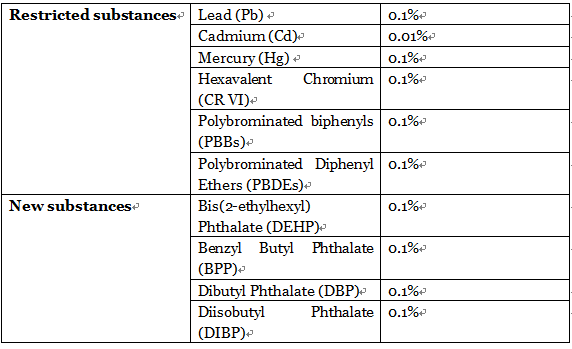
RoHS requirements are mainly used to standardize material and process standards for electrical and electronic equipment, making them more conducive to human health and environmental protection. To this end, many countries will adopt standards that are the same or similar to EU RoHS to limit the hazards of imported products to human health or the consumer environment.
Restrictions on hazardous substances in the Eurasian Economic Union (EAEU) countries are mandatory, and their EAEU-RoHS complies with EAEU Regulation TR 037/2016. Starting from March 1, 2020, if a product complying with TR EAEU 037/2016 is not properly approved, a fine may be imposed as the product will be deemed not to comply with the relevant requirements. The scope of restriction on hazardous substances is the usual 6 items, and the scope of product control is as follows.
1. Household electrical equipment and appliances.
2. Electronic computers and devices connected to them, including combinations thereof.
3. Telecommunications equipment (terminal telecommunications equipment).
4. Office electrical equipment such as photocopiers.
5. Electronic tools (manual and portable motors).
6. Light sources and lighting equipment, including equipment built into furniture.
7. Electronic music tools.
8. Gaming and trading automata.
9. Cash register, bill printer, ID card reader, ATM, information kiosk.
10. Cables, wires and cords for use with rated voltages not exceeding 500 V AC and/or DC, except optical cables.
11. Automatic switching and residual current device.
12. Fire, safety and fire safety detectors.
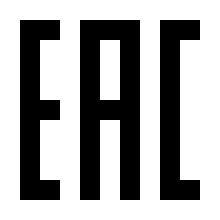
Products that pass the EAEU TR conformity assessment shall be marked with the EAC mark. Marking requirements are as follows:
The implementation of RoHS in European countries is undoubtedly mandatory and follows the provisions of Directive 2011/65/EU,(EU)2015/863 and its amendments, as well as the test standard IEC 62321. RoHS 2.0 limits the scope of hazardous substances to 10 types, and the scope of product control is as follows.
1. Large household appliances
2. Small household appliances
3. IT and telecommunications equipment
4. consumer devices
5. Lighting equipment
6. Electrical and electronic tools
7. Toys, leisure and sports equipment
8. medical devices
9. Measurement and control instruments include industrial measurement and control instruments
10. automatic dispenser
11. Other electrical and electronic equipment not covered by any of the above categories.
Restrictions on DEHP, BBP, DBP and DIBP will apply to all electrical and electronic equipment (except medical equipment and monitoring instruments, but including cables or spare parts required for electrical equipment repair, reuse, function updates or capacity upgrades) from July 22, 2019. Starting from July 22, 2021, the regulation will apply to medical devices and monitoring instruments.
Starting from June 1, 2017, Singapore will enforce RoHS in accordance with EN50581:2012 regulations. The current testing standard is EN 62321, but according to EN 50581:2012, EN 62321 will be replaced by a series of standards designated as EN 62321-x. The limit range of hazardous substances is 6 common types, and the scope of product control is as follows.
1. mobile phone
2. portable computer
3. Refrigerator
4. Air conditioning
5. flat-screen TV
6. washing machine
These controls are implemented at the import stage. Controlled electrical and electronic equipment exceeding the allowable concentration limit of 6HS shall not be imported for local use and distribution after June 1, 2017. However, existing stocks of controlled electrical and electronic equipment imported before June 1, 2017 will be allowed to be sold until these stocks have been exhausted.
Automotive electronics products do not comply with RoHS requirements. Singapore has no clear requirements for RoHS labeling and no requirements for testing laboratories.
United Arab Emirates RoHS is mandatory under ECAS certification and voluntary under EQM certification. Applicable standards are IEC/TR 62476, IEC 63000, IEC 62321-x, IEC 62474 and IEC TR 62474-1. The limit range of hazardous substances is 10, and the scope of product control is as follows:
1. Large household appliances
2. Small household appliances
3. IT and telecommunications equipment
4. Consumer equipment and photovoltaic panels
5. Lighting equipment
6. Electrical and electronic tools (except for large fixed industrial tools)
7. Toys, leisure and sports equipment
8. Medical devices (except all implanted and infectious products)
9. Monitoring and control instruments
10. automatic dispenser
11. Other electrical and electronic equipment not covered by any of the above categories
Restrictions on harmful substances will be implemented in stages: from 2018 to 2020 and then to 2022. From January 1, 2022, limit lead, mercury, cadmium, hexavalent chromium, polybrominated biphenyls and polybrominated diphenyl ethers in medical cables and parts. Devices, in vitro diagnostic medical devices, measurement and control instruments and industrial measurement and control instruments. Limitations of DEHP, BBP, DBP, DIBP in medical devices, in vitro diagnostic medical devices, monitoring and control instruments, industrial monitoring and control instruments (including cables and spare parts).
For automotive electronics, if the product is electrical equipment, ECAS ROHS is required. Test reports should be issued by an ISO 17025 laboratory. There are no special requirements for the ECAS RoHS icon, and the EQM RoHS icon is covered by the EQM certification icon.
In addition to the above four countries, many countries have imposed mandatory restrictions on the concentration of harmful substances, such as Vietnam, Ukraine, Turkey, South Korea, India, etc. However, there is still a lot of room for RoHS globalization. Currently, many countries such as Malaysia, Mexico, South Africa, Thailand, Australia, and Brazil have not yet enforced it. If you would like more information about RoHS restrictions on electrical equipment in the importing country, please feel free to contact us.
 WeChat


 Submission Successful
 WeChat Official Account