-
Xuntong specializes in testing services for electrical accessories, consumer electronics, lighting, wireless, toys and other products.



 Service Hotline 18617145297
On October 14, 2021, the Ministry of Industry and Information Technology issued Document No. 129,”Notice on Strengthening and Standardizing Radio Management in the 2400MHz, 5100MHz and 5800MHz Frequency Bands.” Document No. 129 will be implemented in accordance with the new requirements after October 15, 2023. Model approval.
The differences between the old and new standards are as follows:
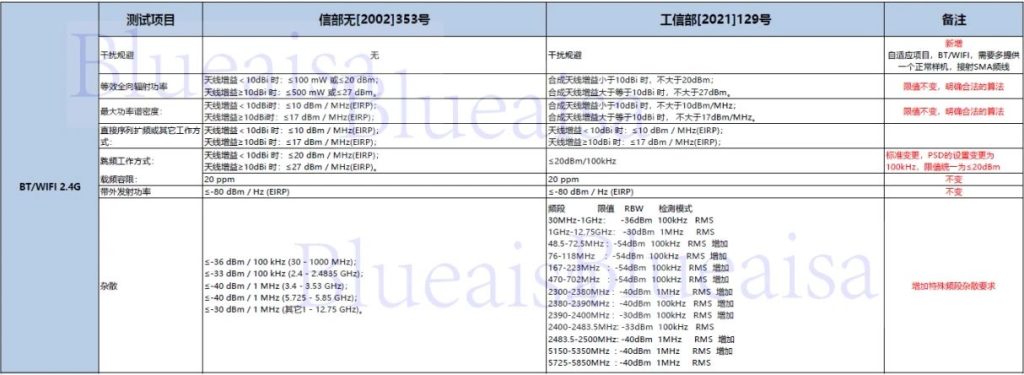
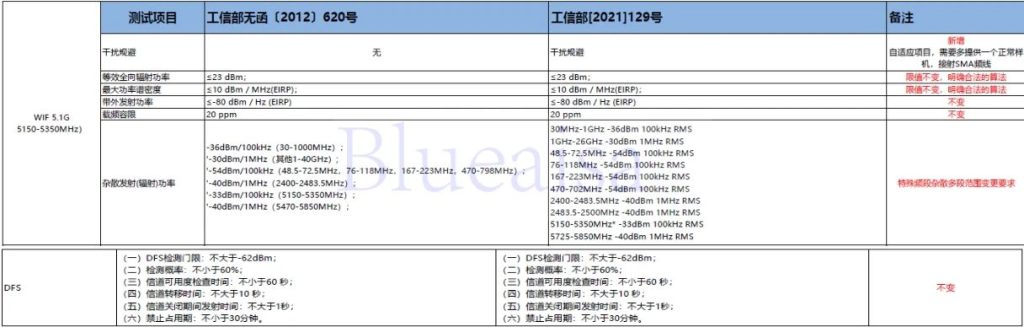
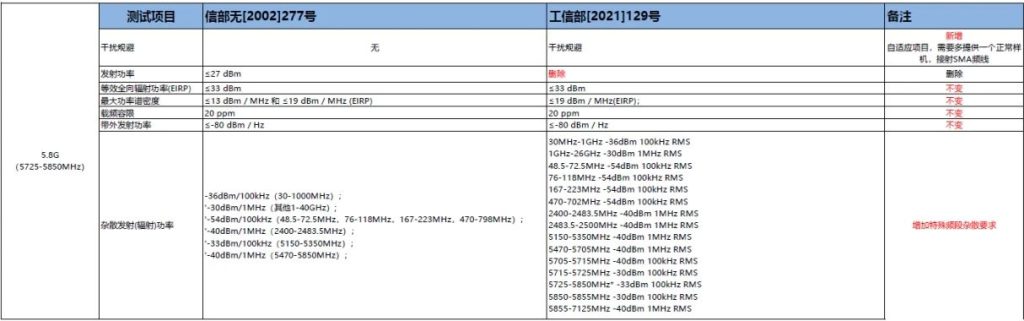
In order to achieve frequency compatible coexistence of different radio systems in the 2400MHz, 5100MHz and 5800MHz frequency bands, improve the anti-interference capabilities of related radio transmitting equipment, and utilize frequency resources efficiently, fairly and rationally, No. 129 has added a variety of interference avoidance technical requirements such as “pre-launch search” for radio transmitting equipment,”Monitoring and avoidance” and “Equivalent Occupancy”.
Radio transmitting equipment operating in the above frequency bands can choose to meet one of the listed requirements:
a. The “pre-launch search” and “monitoring and avoidance” mechanisms refer to monitoring and intercepting the wireless channel to be used at the beginning or during the transmission of a signal, and setting appropriate detection thresholds to determine whether the channel is occupied to select idle channel access;
b. The “equivalent occupancy rate” mechanism means that radio transmitting equipment adaptively adjusts the two parameters of “duty cycle” and “transmit power” to ensure that the “equivalent occupancy rate” is at a low level (no more than 10%).
Please pay attention to the implementation time of the New Deal;
If you have any questions about SRRC, you can contact us at any time.
 WeChat


 Submission Successful
 WeChat Official Account