-
Xuntong specializes in testing services for electrical accessories, consumer electronics, lighting, wireless, toys and other products.



 Service Hotline 18617145297
1. The United States
The U.S. FCC requires the provision of U.S. agency information and the signing of a “non-physical list enterprise statement.”
Recently, the US FCC officially issued the DA/FCC No.: FCC-22-84 “Protecting National Security Threats to the Communications Supply Chain through the Device Authorization Program”(47 CFR Parts 2 and 15 ET Docket No. 21-232 and EA Docket No. 21-233) rule, which mainly uses device authorization to protect the communications supply chain from security threats, restricting the content and equipment on the Covered List.
This rule document mainly involves the following two change points:
1. When submitting the FCC ID, you must also submit the “Statement of Enterprises Not Using the Non-Entity List”;
The services and equipment of manufacturers on the following list cannot be used (cover list): https://www.fcc.gov/supplychain/coverredlist.
2. When applying for FCC ID, you must provide local agent information in the United States (the agent must be a local company in the United States) and provide an “Attestation Statements” statement.
Effective date: February 6, 2023
Regulatory reference: https://www.fcc.gov/document/fcc-amends-equipment-authorization-program.
2. Taiwan
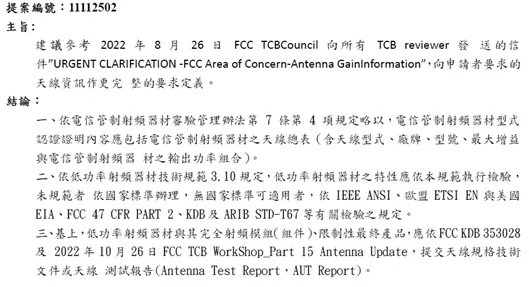
Taiwan’s NCC certification requires a complete antenna report.
In accordance with Proposal 1112502, Taiwan’s NCC requires radio frequency equipment applicants to provide complete antenna specifications or antenna test reports starting from March 1, 2023 (including antenna type/antenna manufacturer and address/antenna manufacturer/antenna model/antenna frequency and Gain value/2D or 3D diagram/antenna photo, etc.).
3. South Korea
South Korea’s National Radio Research Agency announced revisions to relevant testing standards for mobile communication equipment.
As the international standards applicable to 5G mobile communication equipment (ITU/3GPP family standards) continue to be updated, the National Radio Research Institute of Korea (RRA) announced the simultaneous update of relevant test standards for 5G mobile communication equipment, including: 5G NR mobile communication equipment test standards (KS X3270, KS X3271) and wireless equipment test standards (KS X3123).
4. Singapore
Singapore multi-way adapters will need to have the CoC safety mark starting from 2024.
On February 10, 2023, the Office of Consumer Product Safety (CPSO) of Singapore issued notice CPSO-100223-07, according to which, starting from February 11, 2024, all multi-way adapters (traditional multi-way adapters and newly designed multi-way adapters), regardless of shape and design, must bear a valid CoC safety mark before being sold in Singapore. Locally, registered suppliers will be provided with a one-year grace period to test and certify existing products and label them with valid safety signs.
Newly designed multi-way adapters include but are not limited to Example Figure 2 and Example Figure 3

Singapore IMDA opens public consultation on the 6GHz band.
Singapore’s Information, Communication and Media Development Authority (IMDA) launched a public consultation on the “Recommended Allocation of Singapore’s 6GHz Band” on February 14, 2023.
5. EU
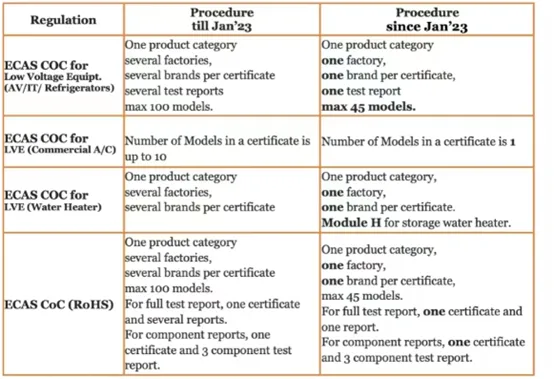
ECAS/ROHS certificates no longer accept multiple countries of origin.
According to ESMA’s latest update, ECAS/ROHS certificates no longer accept multiple countries of origin; each certificate should only mention one country of origin, and if other countries of origin need to be added, a new certificate will need to be applied for.
6. Belarus
Belarus removes mandatory energy efficiency requirements.
On December 29, 2022, Resolution N9916 of the Council of Ministers of the Republic of Belarus “Regulations on Suspension of Resolution No. 849 of the Council of Ministers of the Republic of Belarus of October 21, 2016” officially came into effect.
According to this resolution N916, starting from January 1, 2023, the implementation of Belarus’s mandatory energy efficiency requirements (Article 3 of Resolution No. 849 of the Council of Ministers of the Republic of Belarus of October 21, 2016) will be suspended. Resolution 849 has been suspended indefinitely until a special decision is taken by the Council of Ministers of the Republic of Belarus (possibly until the entry into force of the EAEU Energy Efficiency Technical Regulation (EAEU TR 048/2019))).
Therefore, starting from January 1, 2023, products imported into the Belarusian market should only comply with the requirements of the Eurasian Economic Union Technical Regulations (EAEU) and the Belarusian National Radio/Telecommunications Regulations. Resolution N9 916(Date: December 27, 2022) will take effect on December 29, 2022.
7. Congo
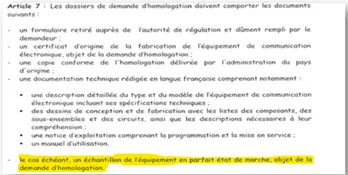
ARPCE in the Republic of Congo requires sending samples for type certification.
The Régulation Post and Communications Electronics Bureau (ARPCE) of the Republic of Congo issued Decree No. 2015-254 on February 19, 2015, article 7 of which stipulates that normal samples must be used for type approval applications. ARPCE is now enforcing this requirement. Currently ongoing and updated projects must provide normal samples to complete the application process, otherwise the application will be cancelled.
8. Brazil
ANATEL Brazil has released a new version of the telecommunications equipment safety testing standard Act 17087 (which will replace the original safety regulation Act 950).
The main changes are as follows:
1. Safety testing will be applicable to telecommunications equipment in all usage environments, provided that end users can directly contact and use the product unconditionally and without restrictions. For example, telecommunications equipment used in buildings (whether civil or commercial), in vehicles, or in aviation equipment without any entry restrictions;
2. Equipment directly powered by mains power must be marked with the rated voltage, current, power and frequency values on the product nameplate; equipment powered by an external AC adapter must be marked with the adapter’s rated voltage, current and power and frequency values on the tie-in adapter nameplate;
3. For battery-powered equipment, if the battery can be directly replaced by the end user, the operating instructions for battery replacement must be noted in the manual of the terminal equipment;
4. The warnings of Class1 products can be reflected in the manual or on the product nameplate;
5. For products sold without adapters, if you need to use a proprietary ANATEL certified adapter, the user manual of the product needs to note the requirements for using a certified adapter to guide consumers in purchasing.
9. Thailand
Thailand’s NBTC officially updates the SDoC application method.
Thailand’s NBTC official announced on its official website in February 2023, updating the SDoC application method, as follows:
Implementation date: February 6, 2023
Updated content:
1. The SDoC processing method has been changed from the original email/offline to online system application:
https://dataportal.nbtc.go.th/
2. Cycle: 3-5 working days (depending on the real-time case volume in the system);
3. Updated SdoC certificate template;
4. The TC issuance method has been changed from affixing the certificate with a physical issuance seal to: an additional authorization letter and a verification QR code will be added on the new version of SDoC;
5. The signature and signature method is changed from the legal person/manager signing and affixing the company’s official seal to:
Print the legal person/manager information directly on the certificate (the personal information of the legal person/manager must be verified online and in the system first).
 WeChat


 Submission Successful
 WeChat Official Account